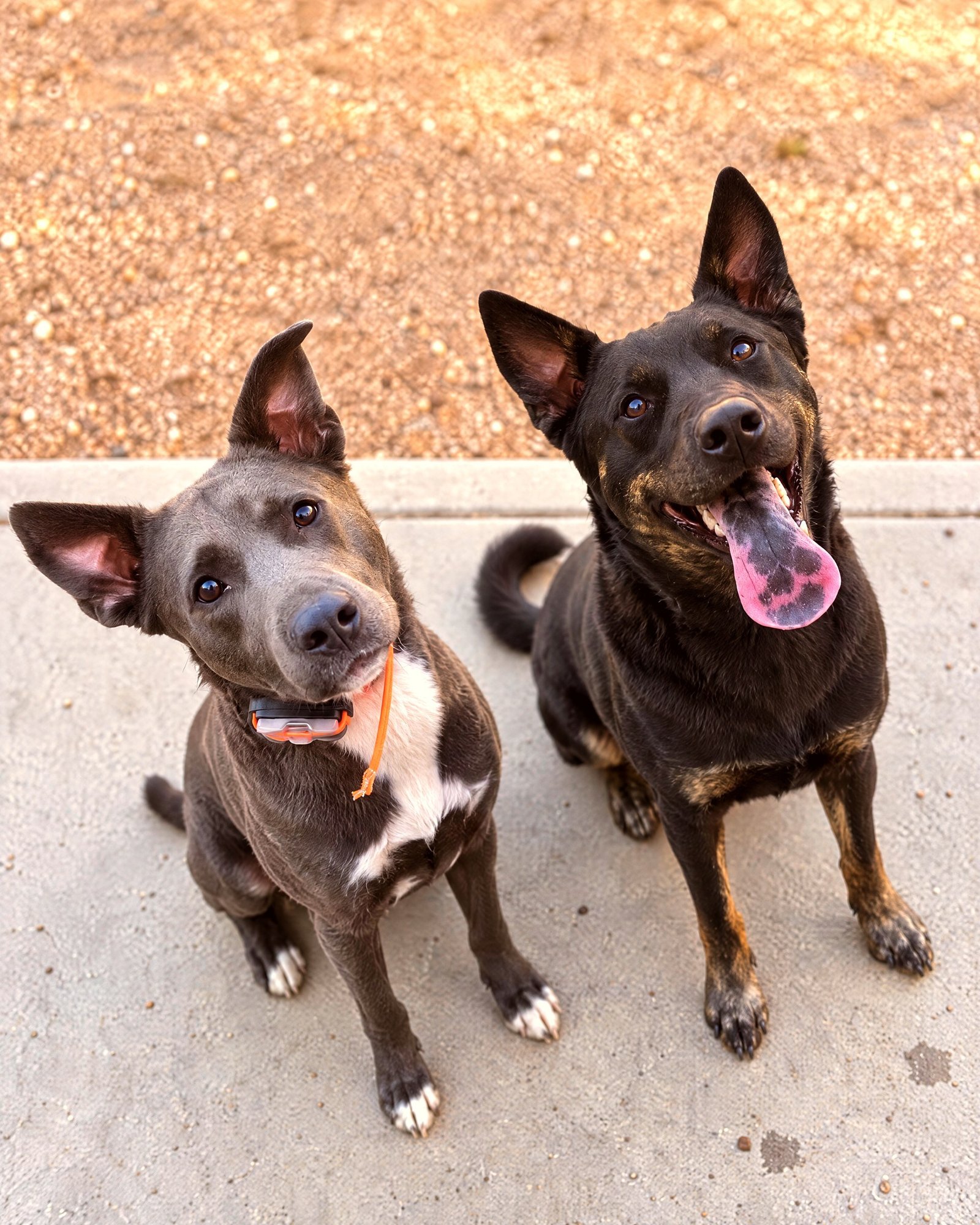
Two alert mixed-breed dogs sitting calmly side by side on an outdoor concrete patio.
Down, at a distance
Est.
Dec 1997
Partners Dogs · Group class syllabus

Put known skills to real work.

Distance commands, Middle, Send Out, and household jobs, built on earlier grades.

CO
CollegeGroup class · pet parents
How class runs

One class shape, every week.

Four focus behaviors a week, and the same flow every class.

  1. Interval the week's four stations
  2. Group whole class together · 15 min
  3. AMRAP your pick, max reps · 5 min
  4. Demo show one, get feedback · 5 min
  5. Home practice the hard ones, before next class
What this grade is for
Practical skills, real control, and a little wow.

College follows High School. Skills grow with distance and everyday jobs, and results vary with the practice you do at home.

What College covers

Manners, behaviors, tricks, and tools.

New Manners

Retrieve Objects, Open/​Close Door, Bow, and Ring Bell To Go Outside.

New Behaviors

Distance Commands, Middle, On The Move Commands, and Send Out.

New Tricks

Play Dead and Sit Pretty, two tricks that show body control.

New Tools

Place/​Touch Pads, Door Tug/​Towel, and named Objects, with your trainer.

Who it is for

Dogs who completed High School and are ready for distance work and household jobs.

Twelve weeks

Four stations each week, with known skills raised a level.

How skills move at this grade

College works all four stages.

New work starts in Teaching. High School skills are reinforced, Middle School skills are proofed, and the basics stay sharp.

a repeat is progress, not a rerun

01

Teaching

Door, bell, Bow, Middle, Send Out, distance, Play Dead, and Sit Pretty.

02

Reinforcing

Kids, sounds, vet handling, pacing, pivots, Bye, Retrieve, Speak, Hug, High Five.

03

Proofing

Objects, grooming, car, Out, Flip to Heel, off leash, Recall to Front, Crawl, Rollover.

04

Maintenance

Daily use at home and in class keeps the foundation sharp. There is no finish line.

Words we use in class

New positions and jobs.

Middle
Your dog stands centered between your legs, facing forward.
Send Out
On one dedicated cue, your dog heads out to a spot or object, finishes the job, and comes back for the reward.
Out
Your dog moves away from a toy, food, area, or person you choose. A different skill from Send Out.
Distance
A cue your dog knows, answered from farther away and paired with a hand signal.
Front
The recall finish: your dog comes and sits squarely in front of you, facing you.
Place
All four paws on the place bed, calm, until you release.
New manners

Useful jobs around the house

Retrieve Objects, Open/​Close Door, Bow, and Ring Bell To Go Outside.

  1. 02New manners
  2. 03New behaviors
  3. 04New tricks
  4. 05New tools
  5. 06Known skills
Retrieve Objects

Bring me the thing.

Object retrieve opens the door to fun, independence, and help around the house.

  1. Pick a favoriteChoose a toy or object your dog already loves to pick up.
  2. Celebrate the pick-upMark and pay every pick-up, then build how long they hold it.
  3. Back awayAs you pay, step back so your dog follows you, item in mouth.
  4. Add Hold or CarrySay it as they come back to you, every time.
  5. Name new itemsMove on to other things one at a time: keys, leash, a toy.
Open/​Close Door

Pull to open, touch to close.

Tie a sturdy tug to the handle

Start with play: tug on a rope and say Pull right before your dog tugs. Then tie the rope to a door handle, leave the door slightly open, cue Pull, and pay the moment the door opens.

To close, use Touch or Paw so your dog puts a nose or paws on an open door. Pay the lean that pushes it, then pay a door that clicks shut.

Takeaways
  • Pull opens
  • Touch or Paw closes
  • Pay every success
Bow

Front legs down, tail end up.

  • Set up sit down on the floor with your dog standing in front of you
  • Lure low bring a treat toward the floor and mark each bend of the front legs
  • Add a signal pair your hand signal while you lure
  • Fade the lure keep the treat a little farther from the floor each session
Be patient

Short and steady

Short, consistent sessions work best. Your dog's pace sets the timeline.

Ring Bell To Go Outside

Ring to ask, then out you go.

A clear way for your dog to ask to go outside, built on a steady potty routine.

  1. Bells on the floorPay any sniff, paw, or nose bump on the bells.
  2. RepeatRun several short rounds until your dog seeks out the bells.
  3. Hold them upHold the bells at nose height and pay each ring.
  4. Hang on the doorMove the bells to the door you use for potty trips.
  5. Every ring opensOpen the door, go out together, and pay outside.
New behaviors

Farther away, and on the move

Distance Commands, Middle, On The Move Commands, and Send Out.

  1. 02New manners
  2. 03New behaviors
  3. 04New tricks
  4. 05New tools
  5. 06Known skills
Distance Commands

Same cue, more distance.

Ask for Sit, Stay, or Come from farther away, for the moments you cannot be right beside your dog.

  1. Solid up closeYour dog answers the cue reliably at a short distance first.
  2. Step back slowlyAdd one more step only after a clean answer.
  3. Pair a hand signalShow the matching signal every time you say the cue.
  4. Stay positiveStep in gently only if needed, then try an easier rep.
  5. Keep your tone lightA stern tone can make some dogs lie down instead.
Middle (between legs)

Right between your legs.

A centered, close position for tricks, confidence, and control in tight spots.

Pro tip · Some families say Between. Pick one word and keep it the same every time.

On The Move Commands

Quick answers while you keep walking.

Cues your dog already knows, answered fast and with less help, out in the real world.

  1. Check indoorsConfirm your dog knows the cue in a calm room first.
  2. Go outside, quietlyPick a spot with few distractions.
  3. Cue on the moveWhile walking, ask for a well-known cue like Sit or Down.
  4. Pay speedLures and rewards keep answers quick. Fade them as speed holds.
  5. Short and upbeatEnd while your dog still wants more.
Send Out

Go out, do the job, come back.

Send Out is not Out

Send Out sends your dog away from you to one clear spot or object, then back to you for the reward. Choose one cue, such as Go find, and keep it separate from fetch and from Out.

Start with a favorite toy three to six feet away in a quiet room, and celebrate the round trip. Add distance or a mild distraction, one at a time. A dog that will not carry can go touch a target pad instead.

Takeaways
  • One clear target
  • One cue, never Out
  • Raise one dial at a time
New tricks

Two tricks that show body control

Play Dead and Sit Pretty.

  1. 02New manners
  2. 03New behaviors
  3. 04New tricks
  4. 05New tools
  5. 06Known skills
Play Dead

Finger gun, then roll to the side.

A fun trick that builds on Down and the head-to-shoulder lure.

  1. Start in a downYour dog lies down in front of you.
  2. Lure to the sideMove the treat from nose to shoulder so they roll onto their side.
  3. Mark and payMark the moment they are on their side.
  4. RepeatPractice until the side roll is smooth on the lure.
  5. Fade to a signalSwap the treat for a finger-gun lure and add the word Bang.
Sit Pretty

Front paws up, sitting tall.

  • Start in a sit your dog sits facing you
  • Lure up raise a treat or toy and pay the second the front paws leave the floor
  • Build the hold pay more as the paws stay up longer
  • Fade the lure switch to your finger as the lure
Support helps

Use a wall

Offer a steady hand, or practice with their back to a wall so they do not tip over.

New tools

Three tools for the new household jobs

Place/​Touch Pads, Door Tug/​Towel, and named Objects. Fit and first uses stay with your trainer.

  1. 02New manners
  2. 03New behaviors
  3. 04New tricks
  4. 05New tools
  5. 06Known skills
New tools

Three tools behind the new skills.

Tool

Place/​Touch Pads

Portable target pads that give your dog a clear spot for distance and Send Out work.

Distance · Send Out
Tool

Door Tug/​Towel

A hanging strap or towel on the handle, used to open and close doors on cue.

Open/​Close Door
Tool

Named Objects

A growing set of everyday items your dog learns by name: keys, leash, a favorite toy.

Trainer guided
Known skills

Known skills, raised a level

High School skills get reinforced, Middle School skills get proofed, and the basics stay sharp.

  1. 02New manners
  2. 03New behaviors
  3. 04New tricks
  4. 05New tools
  5. 06Known skills
Reinforcing: desensitization

Kids, sounds, and vet-style handling.

  • Children start with kids your dog knows, at home; pay calm Sit, Down, or Stay and let your dog choose to approach
  • Sounds a soft knock or doorbell first; raise the volume only while your dog stays calm
  • Medical handling show the tools and practice gentle check-overs at home; fun visits build good feelings
  • Back off when tense stiffening, whining, or refusing food means lower the intensity, or stop and retry later
Read it right

Still is not calm

A frozen dog is not relaxed. Look for soft eyes and an easy body.

Reinforcing: on-leash moves

Pace, pivots, and turns you can feel.

High School movement skills, now with more reps and fewer lures.

  1. PacingSlow down when they drift ahead, speed up for drive, switch to test heel.
  2. Standing PivotsFront paws on a low perch. Circle slowly and mark every few hind steps.
  3. Advanced TurnsPivot on your right foot and finish with a flip to heel.
  4. ByeFrom a stand, lure a clockwise circle around you and pay at heel.
  5. RetrieveGet it, Hold it, then build carry distance.
Reinforcing: tricks

Three tricks that keep class fun.

Speak

Bark on cue

Use a trigger your dog barks at, mark the bark with Yes, and pay. Then say Speak first.

Cue before trigger
Hug

Invite only

Pat your chest to invite, mark the gentle hug, then ask for Off to finish.

Finish with Off
High Five

Paw meets palm

Hold an open hand at reach height. Mark and pay the paw touch, then vary the height.

Paw to palm
Proofing: Middle School skills

Same skills, more distance and distraction.

Front faces you. Heel is at your side.

Proofing turns the five dials: duration, distraction, distance, direction, and difficulty. Objects, textures, grooming, and car rides stay calm in new places. Out moves your dog away from what you choose, and Flip to Heel and off-leash heel hold around people and noise.

Recall to Front stays a Come with a square sit facing you: mark and pay in the sit. Crawl and Rollover come on the cue alone, with the lure faded.

Takeaways
  • Raise one dial at a time
  • Front: square sit facing you
  • Redirect calmly, then retry
Calm and space

Quiet, polite, and four paws on the place bed.

AvoidTry
Repeat the quiet cue louder and louder
Say Quiet/​Settle once and pay the moment barking stops
Greet an excited dog with big energy
Start attention only once your dog settles: no jumping or mouthing
Let your dog rush through an open door
Open wider only while the sit holds, then release through on cue
Count two paws on the place bed as Place
Place means all four paws on the place bed until you release
Handoff Protocol

Pass the leash, keep the position.

Pro tip · Rehearse with a friend before drop-off day. New people and dogs come at your dog's pace, with calm, polite sniffs paid.

Fig. KAsk, mark, pay
PD field guide · known skills
Keep sharp
DAILY short reps · everyday places

Quick, frequent reps of skills your dog already knows: Name/​Watch, Sit, Back-Up, Shake/​Paw, Touch, Reset, and Focused Heel.

For exampleOn a walk

Watch at the curb, Reset when they drift out of heel, Sit at the door, Touch to bring them back to your side. Ask once, mark, pay.

Week 1

Interactive Training & Social Skills

Pro tip · Retrieve Objects: back away as your dog picks up the item, so bringing it to you is the easy choice.

Week 1

Interactive Training & Social Skills

Pro tip · Retrieve Objects: back away as your dog picks up the item, so bringing it to you is the easy choice.

Week 2

Practical Skills & Behavior

Pro tip · Handoff Protocol: pass the leash calmly. The new handler gets your dog's focus first, then pays.

Week 2

Practical Skills & Behavior

Pro tip · Handoff Protocol: pass the leash calmly. The new handler gets your dog's focus first, then pays.

Week 3

Graceful Gestures & Social Acclimation

Pro tip · Medical Socialization: show each tool before you touch. Keep check-overs short and pay calm.

Week 3

Graceful Gestures & Social Acclimation

Pro tip · Medical Socialization: show each tool before you touch. Keep check-overs short and pay calm.

Week 4

Functional Commands & Skill Development

Pro tip · Ring Bell: open the door every time the bells ring, so the bells always mean the door opens.

Week 4

Functional Commands & Skill Development

Pro tip · Ring Bell: open the door every time the bells ring, so the bells always mean the door opens.

Week 5

Refined Commands & Responses

Pro tip · Distance Commands: if an answer gets slow, step closer, pay the fast one, then add distance again.

Week 5

Refined Commands & Responses

Pro tip · Distance Commands: if an answer gets slow, step closer, pay the fast one, then add distance again.

Week 6

Innovative Moves & Familiar Skills

Pro tip · Threshold Protocol: open the door wider only while your dog holds the sit. Release through on your cue.

Week 6

Innovative Moves & Familiar Skills

Pro tip · Threshold Protocol: open the door wider only while your dog holds the sit. Release through on your cue.

Week 7

Dynamic Commands & Environmental Adaptation

Pro tip · On The Move: keep sessions short. Pay fast answers and keep walking between cues.

Week 7

Dynamic Commands & Environmental Adaptation

Pro tip · On The Move: keep sessions short. Pay fast answers and keep walking between cues.

Week 8

Empowered Interactions & Calm Composure

Pro tip · Send Out heads to one clear target and comes back. Out means move away. Keep the two cues different.

Week 8

Empowered Interactions & Calm Composure

Pro tip · Send Out heads to one clear target and comes back. Out means move away. Keep the two cues different.

Week 9

Engaging Tricks & Polished Etiquette

Pro tip · Calm Greetings: the hello starts once your dog settles. Jumping, mouthing, or whining pauses it.

Week 9

Engaging Tricks & Polished Etiquette

Pro tip · Calm Greetings: the hello starts once your dog settles. Jumping, mouthing, or whining pauses it.

Week 10

Graceful Poses & Skilled Tasks

Pro tip · Sit Pretty: let your dog lean on a wall for support at first while balance builds.

Week 10

Graceful Poses & Skilled Tasks

Pro tip · Sit Pretty: let your dog lean on a wall for support at first while balance builds.

Week 11

Interactive Engagement & Controlled Responses

Pro tip · Place means all four paws on the place bed. Pay the arrival, then build calm time there.

Week 11

Interactive Engagement & Controlled Responses

Pro tip · Place means all four paws on the place bed. Pay the arrival, then build calm time there.

Week 12

Tactile Commands & Focused Movements

Pro tip · Touch: pay a quick nose bump on your palm, then move your hand a little farther away.

Week 12

Tactile Commands & Focused Movements

Pro tip · Touch: pay a quick nose bump on your palm, then move your hand a little farther away.

Between classes
Take home the station that gave you trouble.

A few short sessions on the difficult commands before next class keep the week moving. Results vary with practice.

Fair questions

Class logistics parents usually ask.

Who joins College?

Dogs who completed High School and are ready for distance work and household jobs.

Where do we train?

Group classes meet at our Scottsdale and Cave Creek campuses.

Can we start any week?Open enroll

Yes. Open enrollment runs year-round, so you can start any week.

What do we practice at home?

The commands your dog finds hardest. Photos or videos help us give you feedback.

Thank you

See you on the floor.

480.595.6700
partnersdogs.com/grade-levels/college
Scottsdale · Cave Creek, Arizona