Our Training Methodology
How We Train, in Plain English: The Right Tool for Your Dog
We are balanced, tool-agnostic trainers. We use the equipment that best serves your dog, your family, and the relationship between you. Treats, clickers, slip leads, prong collars, e-collars, bark collars, place training: whichever tool fits the dog in front of us.
Is Partners Dog School force-free or balanced, and do you use e-collars?
Partners Dog School practices balanced, tool-agnostic training: we use the full range of humane tools and methods, treats, markers, clickers, slip leads, prong collars, and modern e-collars, and choose what fits each individual dog. We are not a force-free shop and we do not pretend e-collars and prongs do not exist. Used skillfully by a trained professional, they are clear, low-stress communication tools, not punishment. The honest truth after 70,000+ dogs is this: tools do not cause harm, poor handling does. We match the right tool to the right dog at the right stage, teaching, reinforcing, proofing, then maintenance, and we educate you so the results last for life.
BALANCED AND TOOL-AGNOSTIC
The Big Picture: We Read the Dog, Then Choose the Tool
Partners Dogs is balanced. That means we do not limit ourselves by equipment and we do not pre-commit to a single methodology. We use the tool, technique, and training style that best serves the dog and the owner: something that improves the relationship, makes training clear, and is simple to continue long after your program ends.
Tools do not cause harm. People do. Any piece of equipment can hurt a dog when used incorrectly, and almost any piece of equipment can build a confident, well-mannered dog when used by a trainer who understands the timing, the conditioning, and the pairing. Our job is to be that trainer.
After 70,000+ dogs and 28+ years, we have yet to find one method that works for every dog. That is why we keep every humane option on the table and choose what actually works for the animal in front of us.
Family-owned since 1997. 70,000+ dogs trained. 4.8 stars across roughly 2,000 reviews. Two Arizona campuses, Scottsdale and Cave Creek.
See transparent pricing Read the reviews Take the PD360 assessment, no judgment
THE SCIENCE BEHIND TRAINING
The 4 Quadrants of Operant Conditioning
Modern dog training is built on operant conditioning. Here are the four quadrants and how we use or avoid each one. Positive Punishment is not where we start. It is one tool in a much bigger toolbox, used after the dog has been taught the alternative and conditioned to the equipment. The skill of the trainer, not the quadrant, determines whether a tool builds a great dog or breaks one.
+R (Positive Reinforcement). Add something good when the behavior happens. Treats, praise, play. Our primary method and the foundation of every program we run.
-R (Negative Reinforcement). Remove something uncomfortable when the behavior happens. Leash pressure releases the moment the dog yields, for example. Clear, low-stress, and widely used.
+P (Positive Punishment). Add something the dog wants to avoid to decrease a behavior. We use this when it is the right communication for the dog, always paired with prior conditioning, always at the lowest level the dog perceives, such as an e-collar stim that functions as a tap on the shoulder.
-P (Negative Punishment). Remove something good to decrease a behavior. Turning away when a dog jumps removes the attention the dog wanted. Simple and effective for nuisance behaviors.
THE FULL TOOLBOX
Tools We Use and How
- Treats and markers (clicker or verbal marker). The clearest, fastest way to communicate "yes, that's it" to a dog. The foundation of how we build every new behavior.
- Flat collar and leash. Daily walks, foundation training. The everyday baseline for every dog we work with.
- Long line. For recall and off-leash transition, a safety net while a dog is learning distance work.
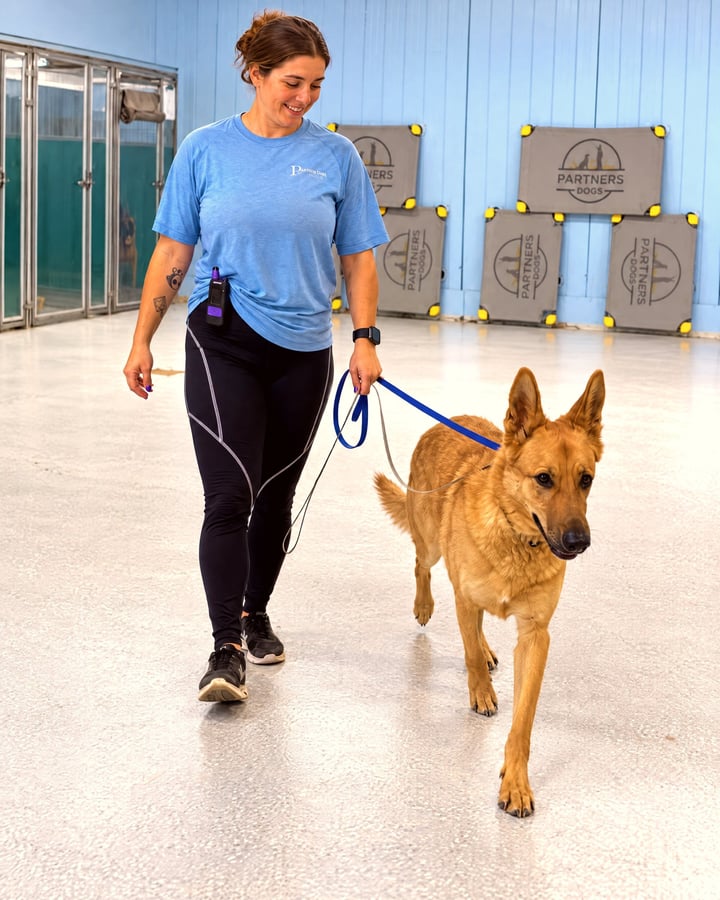
- Slip lead or slip collar. Clean, simple communication when fitted high on the neck and used correctly. Common in our intake protocol.
- Prong collar. Used when it is the right fit for the dog, often safer than a flat collar for hard pullers who choke themselves on pressure. Always fitted correctly, always paired with leash skills.
- E-collar or remote collar. Used in Transform Camp, advanced recall, and snake-avoidance work. Always introduced with proper conditioning, always at the level the dog perceives as a tap on the shoulder. Lets us communicate clearly at distance and off-leash.
- Bark collar. Used when nuisance barking is degrading the dog's quality of life or the household's. Properly conditioned and matched to the dog, not a set-and-forget device.
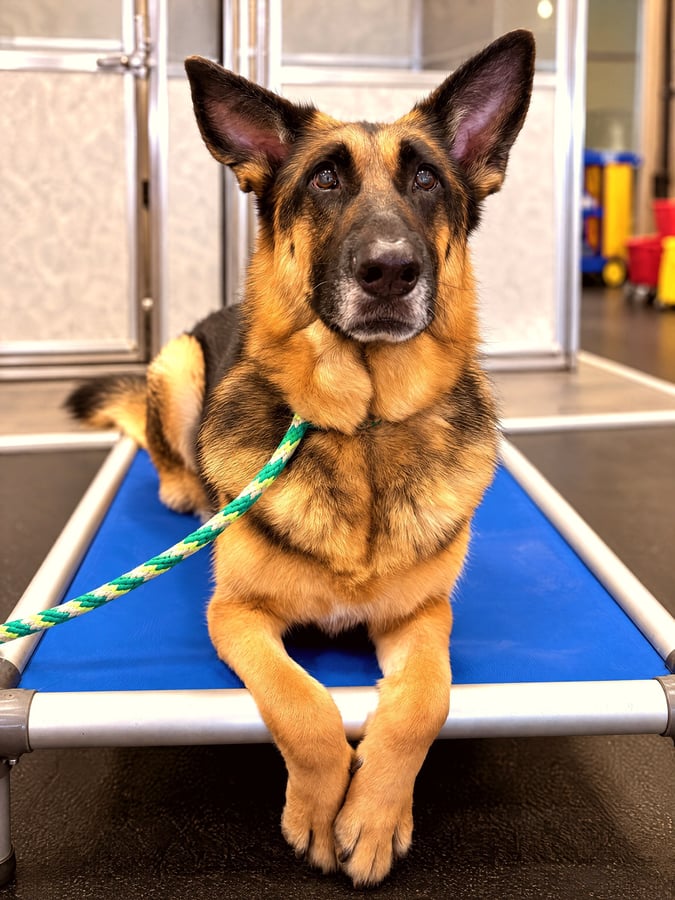
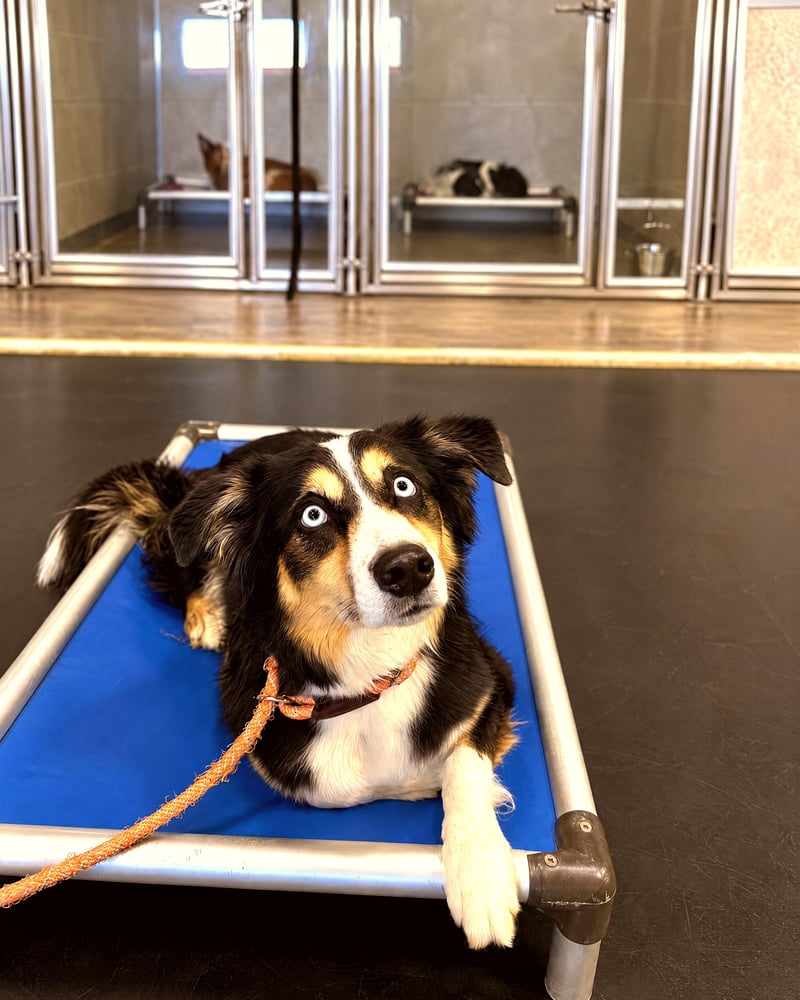
- Place training (cot, mat, or bed). Our most versatile household-manners tool. Solves jumping, door-bolting, begging, and chaos. Teaches the dog to settle on cue anywhere you need it.
- Crate. For management and safety, conditioned as a den. A well-introduced crate is a place dogs choose to rest, not a penalty box.
- Basket muzzle. For safety in some behavior-modification cases. Comfortable, breathable, and conditioned positively before any working use.
TEACH, REINFORCE, PROOF, MAINTAIN
How We Build Every Behavior: The PD360 Process
A tool only matters if the behavior behind it is built correctly. Every skill we train, from a first sit to off-leash reliability around real distractions, moves through the same four stages, and PD360 tracks exactly where your dog stands on each one so progress is never a guess.
Step 1. Teaching. We introduce the behavior in a calm, low-distraction setting and show your dog exactly what earns the reward. The goal here is understanding, not perfection. Your dog learns what the cue means and how to get it right.
Step 2. Reinforcing. We repeat and reward until the behavior becomes a habit instead of a lucky guess. A cue your dog kind of knows turns into one they offer quickly and willingly, every time.
Step 3. Proofing. We test the behavior against real life: distractions, distance, and duration, in new places and around other dogs and people. A sit that only works in a quiet room is not finished. Proofing is what makes it hold at the front door, the vet, and the park.
Step 4. Maintenance. Skills fade without practice, so we build simple habits that keep the behavior sharp for life and coach you to carry them on at home long after your program ends.
Every behavior in your dog's plan is tracked in PD360, so you and your trainer always know which skills are solid, which are still proofing, and what to work on next. Most dogs start with a PD360 Assessment, an honest evaluation that shows where your dog stands today and matches them to the right program. If another trainer has turned your dog away for reactivity or aggression, that is exactly the kind of case this assessment is built for.
HARD LINES
What We Will Never Do
Being tool-agnostic does not mean anything goes. There are practices we will not use because they damage the relationship and they do not produce lasting results.
- Alpha rolls, scruff shakes, and dominance theory. Bad science and bad outcomes. We do not train this way.
- Hot-stove setups. We do not engineer failures to teach a lesson. The dog should always have a clear path to success.
- Yelling, hitting, or training out of anger. Never. If a trainer is frustrated, the dog goes to a crate and the trainer takes a breath.
- Using any tool before conditioning the dog to it. Equipment is communication, not surprise. We teach the dog what the tool means before we ask anything of them with it.
- Pre-committing to a methodology over the dog in front of us. Dogma in either direction, force-free purism or correction-first, is the wrong answer. The dog tells us what works.
OUR TRAINING PHILOSOPHY
The 5 Principles We Live By
Everything above flows from these five principles. They guide every program, every plan, and every trainer at Partners Dogs.
- Set the dog up to succeed. Make the right behavior easier than the wrong one, in every session, every time.
- Match the tool to the dog. We do not pre-commit to a methodology. The right tool is the one that makes training clearer, faster, and more sustainable for this dog and this family.
- Build the relationship first. A dog that trusts you will work for you. A dog that fears you will only comply when you are watching.
- Be honest about what works. If an approach is not producing results, we change it. No ego, no ideology, just what the dog in front of us actually responds to.
- Respect the individual dog. Breed is a hypothesis. The actual dog in front of you is the evidence. We train the animal, not the assumption.
CREDENTIALED AND ALWAYS LEARNING
How We Train and Certify Our Team
Certified through Partners Dogs University. Every trainer on our team earns their certification through our own program at university.partnersdogs.org, built and taught by our most experienced trainers.
The most rigorous process we have seen. Before a trainer ever works your dog on their own, they complete more structured onboarding, mentorship, and supervised floor hours than we have found at any other dog school.
Ongoing career development. Our trainers keep advancing through continued coursework, skill checks, and mentorship from senior staff, so the person with your dog is always sharpening their craft.
Trained on real dogs, at real scale. Since 1997 our team has worked with more than 70,000 Arizona dogs, so your trainer has handled your dog's exact challenge many times before.
One standard at every campus. Because every trainer is developed and certified the same way through Partners Dogs University, you get the same high standard in Scottsdale and Cave Creek.
AKC Canine Good Citizen Evaluators on staff. Our team includes certified AKC CGC Evaluators, so your dog can train toward and earn the Canine Good Citizen title with the same people who prepared them for it.
Want to know more about the trainer who will work with your dog? Ask during your PD360 Assessment.
GO DEEPER
Keep Reading
- Training FAQ Common questions about programs, tools, timelines, and what balanced training actually costs.
- PD360 Assessment Where most behavior cases start, an honest evaluation that matches your dog to the right program.
- Training Glossary Plain-English definitions of every term you will hear from our trainers.
- Behavior Camp Find your dog's specific behavior and the program that addresses the root cause.
Want to Talk Through the Methodology Before You Enroll?
A short call with a senior trainer answers most methodology and tool questions before you commit to a program. No pressure, no upsell, just straight answers about how we train and whether your dog is a fit.
Frequently Asked Questions
Do you use shock collars, prong collars, or e-collars?
We use prong collars and modern e-collars as part of a balanced toolkit, alongside treats, markers, and leash work. A modern e-collar communicates with a low-level cue, not a shock, and only a trained professional decides if and how any tool fits your dog.
Is balanced training safe?
Yes, when done by skilled hands. With a skilled team of professional trainers and 28+ years of experience, we pair the right tool with the right dog and prioritize the dog's wellbeing and the relationship over any single ideology.
Why aren't you force-free?
Because limiting ourselves to one method limits outcomes for the dog. We have found that dogs and families succeed most when we keep every humane tool on the table and choose responsibly based on the individual dog in front of us.
How are your trainers certified?
Every Partners Dogs trainer is certified through Partners Dogs University, our own training and certification program at university.partnersdogs.org. Instead of outsourcing credentials, we built what we believe is the most rigorous in-house development process in the field: deep onboarding, mentorship under senior trainers, hundreds of supervised floor hours, and continued career development. Ask about the specific trainer who will work with your dog during your PD360 Assessment.
What training methods will you never use?
Alpha rolls, scruff shakes, dominance theory, hot-stove setups, yelling, hitting, or training out of anger. We also never apply any tool we have not first conditioned the dog to understand. Equipment is communication, not surprise.