Skip to content
Now Booking Family-owned · 28+ years · 70,000+ dogs trained
📞 480-595-6700 enroll@partnersdogs.com
    Home
    Programs
    Locations
    Resources

    Pet Parenting Class · 8 Cumulative Grade Levels

    Group Classes: Pre-School to Dogtorate

    Transforming everyday pets into the world's smartest dogs. 8 progressive grade levels, 115+ behaviors tracked in PD360 (and growing), open enrollment so you can start any week.

    Group classes at Partners Dogs are weekly small-group obedience training sessions at our Scottsdale and Cave Creek facilities. We teach a cumulative 8-grade-level curriculum, from Pre-School puppy socialization through Dogtorate-level off-leash reliability, covering 115+ behaviors tracked in our PD360 system.

    Sessions are taught by master trainers in groups of 6 dogs or fewer, with open enrollment so you can start any week. Drop-in classes are $65 per session ($115 same-day at the door), and every grade level's full syllabus is readable online with skills, week-by-week plans, and PD360 scoring for all 8 levels.

    Class Format

    45 Minutes, Built for Reps

    Every class runs the same 45-minute shape. Each block does a specific job in moving your dog's skills from new to reliable, so progress compounds week over week.

    1. Interval, 20 minutes. Focused reps at rotating stations.
    2. Group, 15 minutes. Whole-class work around distraction.
    3. AMRAP, 5 minutes. Rep volume on one behavior.
    4. Demo, 5 minutes. Trainer feedback and the take-home focus.
    5. Total class length, 45 minutes.
    Interval 20 min

    Focused reps at rotating stations

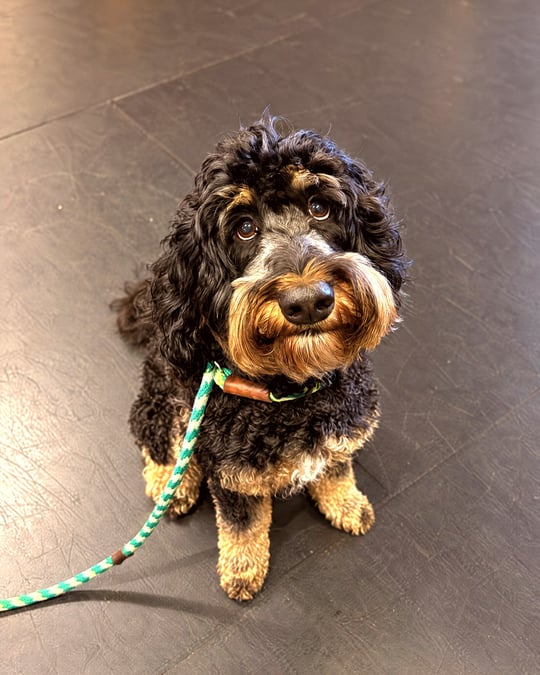
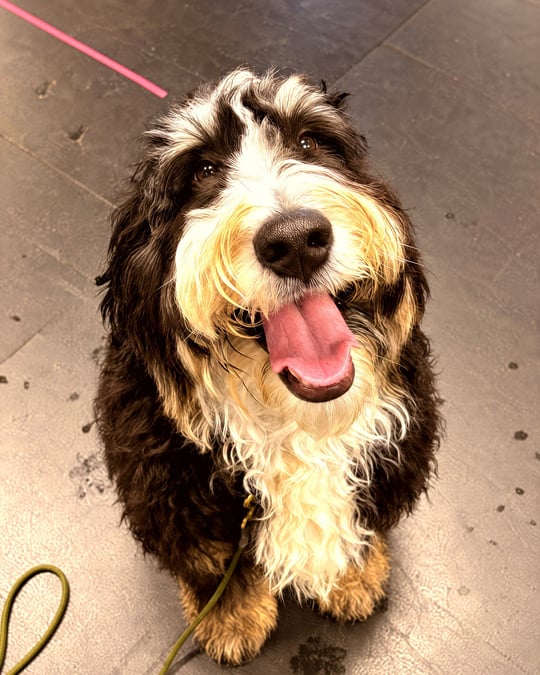
    Small groups cycle through four stations, and this is where new stages are earned. The concentrated repetition at each station is what moves a skill from first attempt toward reliable.
    Group 15 min

    Whole-class work around distraction

    The full class works one behavior together, which proofs skills against the pull of other dogs and handlers. Holding a behavior in that environment is what makes it hold at home.

    AMRAP 5 min

    Rep volume on one behavior

    Parents pick one behavior and drill successful completions before time runs out. The volume of clean reps builds the muscle memory that turns a known skill into an automatic one.

    Demo 5 min

    Trainer feedback and the take-home focus

    Your trainer demonstrates a focus command, corrects what needs correcting, and sets the one thing to practice that week. That feedback loop keeps every dog moving in the same direction.

    What Makes These Classes Different

    Open Enrollment

    The structure is modular, so you can miss a class without losing progress. Behaviors repeat within a Grade Level, and you can repeat a Grade Level as many times as needed.

    Comprehensive Curriculum

    115+ behaviors tracked in PD360 (and growing) across all 8 grade levels. Graduate through Pre-School to Dogtorate alongside your dog.

    High Energy, Higher Impact

    Copious reps in every session so you leave feeling fulfilled and confident to continue your dog's progress at home.

    Stay In Sync

    Progress in each Grade Level carries through to other Partners programs: Foundation Camp, DaySchool, Behavior Camp, and beyond.

    Flexible Scheduling

    Numerous options per class plus an extended public schedule, so participating works even when life gets busy.

    Cumulative Learning

    A behavior in Teaching at one level is Reinforcing at the next, then Proofing, then Maintenance, so nothing is learned once and forgotten.

    Behavior Progress Plan

    The Curriculum Ascent

    Watch the curriculum climb. Each grade stacks new behaviors on top and pushes everything underneath a stage deeper, so your dog knows more and knows it at mastery depth. How the points behind each column are counted is right below.

    • Teaching
    • Reinforcing
    • Proofing
    • Maintenance

    Every level adds new behaviors on top and pushes everything underneath a stage deeper.

    Counts reflect each level's stage mix, including skills refreshed back into Teaching.

    1. Pre-School: 14 behaviors in Teaching at this level.
      Pre-School 184 pts
    2. Kindergarten: 14 behaviors in Reinforcing.
      Kindergarten: 15 behaviors in Teaching at this level.
      Kindergarten 235 pts
    3. Elementary: 14 behaviors in Proofing.
      Elementary: 15 behaviors in Reinforcing.
      Elementary: 15 behaviors in Teaching at this level.
      Elementary 309 pts
    4. Middle-School: 14 behaviors in Maintenance.
      Middle-School: 15 behaviors in Proofing.
      Middle-School: 15 behaviors in Reinforcing.
      Middle-School: 15 behaviors in Teaching at this level.
      Middle-School 393 pts
    5. High-School: 29 behaviors in Maintenance.
      High-School: 15 behaviors in Proofing.
      High-School: 15 behaviors in Reinforcing.
      High-School: 12 behaviors in Teaching at this level.
      High-School 453 pts
    6. College: 44 behaviors in Maintenance.
      College: 15 behaviors in Proofing.
      College: 12 behaviors in Reinforcing.
      College: 13 behaviors in Teaching at this level.
      College 507 pts
    7. Masters: 59 behaviors in Maintenance.
      Masters: 12 behaviors in Proofing.
      Masters: 13 behaviors in Reinforcing.
      Masters: 15 behaviors in Teaching at this level.
      Masters 553 pts
    8. Dogtorate: 71 behaviors in Maintenance.
      Dogtorate: 13 behaviors in Proofing.
      Dogtorate: 15 behaviors in Reinforcing.
      Dogtorate: 16 behaviors in Teaching at this level.
      Dogtorate 620 pts
    1. Graduation 1 Pre-School
      14 behaviors 184 target

      New here: Confidence, Etiquette, Socialize.

    2. Graduation 2 Kindergarten
      29 behaviors 235 target

      New here: Play Guidance, Hand Off, Desensitize.

    3. Graduation 3 Elementary
      44 behaviors 309 target

      New here: Calm, Boundaries, Greetings.

    4. Graduation 4 Middle-School
      59 behaviors 393 target

      New here: Objects Desensitization, Grooming, Car Socialization.

    5. Graduation 5 High-School
      71 behaviors 453 target

      New here: Child Desensitization, Sounds Desensitization, Medical Socialization.

    6. Graduation 6 College
      84 behaviors 507 target

      New here: Retrieve Objects, Bow, Open/Close Door.

    7. Graduation 7 Masters
      99 behaviors 553 target

      New here: Wipe The Floor, Put Away Toys, Turn Off Lights.

    8. Graduation 8 Dogtorate
      115 behaviors 620 target

      115 behaviors carried at mastery depth. Dogtorate graduates are some of the smartest dogs in the world, and they live like it.

      Start the climb

    PD360 Progress

    How Scoring Works

    Every skill your dog knows sits at a stage, and each stage is worth points. As behaviors move up, the score climbs toward each grade's graduation target, the same score across every Partners program.

    1 Stage 1 of 5 Unknown Not yet on the map

    The behavior is not yet in your dog's vocabulary. Every skill starts here, and the first Teaching rep moves it onto the map.

    Ready to move on when The first Teaching session begins.

    2 Stage 2 of 5 Teaching Where the behavior takes shape

    Teaching is shaping, luring, integrating, conditioning, and desensitization. The goal behavior is built piece by piece in a low-distraction setting.

    What happens here
    • Shaping
    • Luring
    • Integrating
    • Conditioning
    • Desensitization

    Ready to move on when You see recognition, and often anticipation, of the goal behavior.

    3 Stage 3 of 5 Reinforcing From every time to any time

    Reinforcement starts continuous and moves to variable. All four quadrants can be used in this phase as long as the dog continues to recognize the goal.

    What happens here
    • Continuous reinforcement
    • Variable reinforcement
    • All four quadrants
    • Goal recognition checks

    Ready to move on when Your dog shows full comprehension of the goal.

    4 Stage 4 of 5 Proofing The five D's, everywhere it matters

    Proofing continues with duration, distraction, distance, direction, and difficulty. It takes the longest because it is an ever evolving process: it solidifies the behavior, finding strengths and uncovering weaknesses.

    What happens here
    • Duration
    • Distraction
    • Distance
    • Direction
    • Difficulty

    Ready to move on when The behavior holds up in new places, around new distractions, at new distances.

    5 Stage 5 of 5 Maintenance Progression prevents regression

    Maintaining continues indefinitely. Skills stay sharp because they keep getting used: in class, at DaySchool and DayCamp, during boarding, and at home.

    What happens here
    • Ongoing practice
    • Real-world use
    • Cross-service continuity
    • PD360 tracking

    No finish line. Skills stay sharp because they keep getting used, so hard-won gains never slip back.

    Every skill your dog knows sits at one of five stages, and each stage is worth points. A grade level's score is the sum of those stage scores across every skill met so far. As behaviors move up a stage the score climbs, and when it reaches the graduation target the move up is obvious.

    The same score follows your dog across Group Classes, DaySchool and DayCamp, private lessons, and boarding, keeping parent, dog, and trainer in sync.

    1. Pre-School 14 cumulative skills Graduation target 28 points
    2. Kindergarten 29 cumulative skills Graduation target 72 points
    3. Elementary 44 cumulative skills Graduation target 131 points
    4. Middle-School 59 cumulative skills Graduation target 205 points
    5. High-School 71 cumulative skills Graduation target 274 points
    6. College 84 cumulative skills Graduation target 342 points
    7. Masters 99 cumulative skills Graduation target 412 points
    8. Dogtorate 115 cumulative skills Graduation target 484 points

    Tap any grade to open its full syllabus and progression.

    14 new behaviors · 14 cumulative

    Pre-School

    Puppy & Adult

    Pre-School is the first step in our 8-level curriculum. Dogs learn manners, socialization, and proper play while building confidence and desensitizing to sights and sounds that can trigger reactivity. These crucial skills develop the fundamental aspects of a well-rounded dog and prepare them for everything to come.

    Pre-School runs as two tracks, Puppy (5-12 months) and Adult (12+ months), so your dog learns alongside peers at a similar life stage. Most dogs graduating from our board-and-train Camps enter at Kindergarten, but outwardly reactive dogs start in Pre-School (Adult) for focused support before moving up.

    Set Up Important Boundaries

    Educate your dog in a positive, engaging, and enduring manner to distinguish between right and wrong behaviors.

    Key Training for Adolescent Dogs

    Learning and socializing contribute to a dog's mental stimulation and overall well-being, setting a foundation for a happy and healthy adult dog.

    Prepare Your Dog For Success

    Early learning experiences help dogs build confidence, reduce anxiety, and prevent behavioral issues as they grow older.

    Pre-School Syllabus

    New Manners

    ConfidenceEtiquetteSocializeCuesGentleness

    New Behaviors

    NameSitMarkersCrateDown

    New Tricks

    Spin

    New Tools

    Slip LeadMartingaleTreats

    15 new behaviors · 29 cumulative

    Kindergarten

    All Ages

    In Kindergarten, dogs learn to be mindful of thresholds, stay focused through turns, hold steady in place, and understand the concept of being free. The curriculum builds on Pre-School with lessons on manners, socialization, and proper play while continuing to boost confidence and exposure to various sights and sounds.

    This is where most dogs land after graduating from a Partners board-and-train Camp. The foundations built here (heel, place, stay) anchor every higher-level behavior your dog will learn.

    Behavioral Foundations

    The class focuses on training dogs to meet specific behavioral thresholds, including mastering turns and staying in place. These foundational behaviors are crucial for development.

    Confidence and Socialization

    Exposing dogs to different sights and sounds helps reduce reactivity, build confidence, and develop socialization skills and manners for interacting with others.

    Manners and Play

    Lessons focus on teaching dogs proper play techniques and manners to engage appropriately and respectfully. Structured activities reinforce positive behavior during social ...

    Kindergarten Syllabus

    New Manners

    Play GuidanceHand OffDesensitizeImpulse ControlThresholds

    New Behaviors

    HeelTurnsStayPlaceFreeRecall

    New Tricks

    Shake

    New Tools

    Training CollarHarnessTreadmill

    15 new behaviors · 44 cumulative

    Elementary

    All Ages

    In Elementary, dogs reinforce skills from Kindergarten while learning advanced commands and behaviors crucial for daily interactions. This stage focuses on refining obedience, improving impulse control, and enhancing social manners.

    The signature commands of this level, Reset, Done, Leave It, and Off, are the ones your dog will use every single day at home, on walks, and in public spaces.

    Advanced Commands

    Dogs learn and practice new commands such as "Reset," "Done," "Leave It," and "Off," which are essential for managing behavior in various situations.

    Impulse Control

    Training emphasizes self-control, teaching dogs to resist temptations and respond calmly to commands like "Leave It" and "Off," which are vital for safe and respectful ...

    Social Manners

    The curriculum includes lessons on appropriate play and greetings, ensuring dogs know how to engage with other dogs and people in a polite and controlled manner.

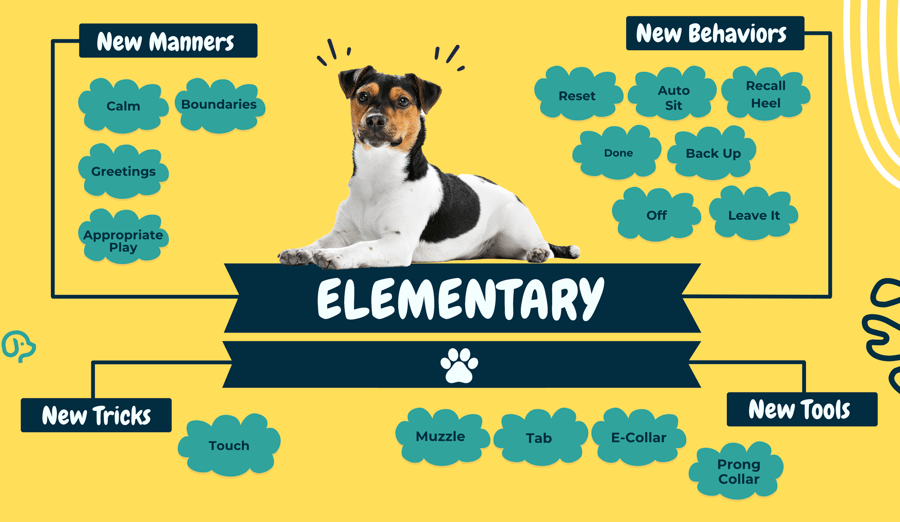
    Elementary Syllabus

    New Manners

    CalmBoundariesGreetingsAppropriate Play

    New Behaviors

    ResetAuto SitDoneBack UpOffLeave It

    New Tricks

    Touch

    New Tools

    MuzzleTabE-CollarProng Collar

    15 new behaviors · 59 cumulative

    Middle-School

    All Ages

    In Middle-School, dogs advance their training with specialized commands and skills that enhance their ability to navigate more complex environments. This level focuses on precise obedience, grooming tolerance, and desensitization techniques.

    This is also where structured off-leash work and longer-line exercises begin. Your dog earns more freedom by demonstrating consistent obedience.

    Specialized Commands

    Dogs are introduced to commands like "Out" and "Flip to Heel," which are designed to improve positioning and responsiveness during walks and other activities.

    Grooming Tolerance

    Training includes sessions on grooming, helping dogs become comfortable with being handled and groomed, which is essential for their overall health and well-being.

    Object Desensitization

    The curriculum incorporates object desensitization exercises, teaching dogs to remain calm and unreactive when exposed to various objects and stimuli, reducing anxiety and ...

    Middle-School Syllabus

    New Manners

    Objects DesensitizationGroomingCar Socialization

    New Behaviors

    Recall to FrontFlip to HeelOff LeashOut

    New Tricks

    CrawlRollover

    New Tools

    Bark CollarLong LineTreat & TrainAgility WeavesAgility TunnelAgility Jump

    12 new behaviors · 71 cumulative

    High-School

    All Ages

    In High-School, dogs reinforce and proof basic commands and manners while expanding into more complex behaviors that enhance their ability to engage in interactive and cooperative tasks. This level focuses on building advanced tricks, emotional bonding, and practical retrieval skills.

    The desensitization work at this level, covering children, sounds, and medical handling (taking vitals), is what makes Partners-trained dogs comfortable in the real world.

    Advanced Tricks

    Dogs are taught fun and engaging tricks like "High Five," "Hug," and "Bye," which not only entertain but also strengthen the bond between the dog and handler.

    Emotional Bonding

    Through commands like "Hug," dogs learn to engage in close, affectionate interactions that promote trust and deepen the emotional connection with their handlers.

    Practical Skills

    Training includes the "Retrieve" command and pacing exercises, helping dogs perform useful tasks and maintain controlled movement, which is important for both work and play.

    High-School Syllabus

    New Manners

    Child DesensitizationSounds DesensitizationMedical Socialization

    New Behaviors

    PacingPivotsByeRetrieve

    New Tricks

    SpeakHigh FiveHug

    New Tools

    ThermometerNoise-Makers

    13 new behaviors · 84 cumulative

    College

    All Ages

    In College, dogs focus on reinforcing and proofing previously learned behaviors while adding complex and functional behaviors that demonstrate high levels of obedience, problem-solving, and physical control. This level focuses on tasks that are both practical and impressive, showcasing your dog's advanced training and versatility.

    Functional Commands

    Dogs learn practical skills like "Open/Close Door" and "Send Out," enabling them to perform tasks that assist in daily activities and enhance their usefulness in various settings.

    Advanced Positioning

    Commands like "Middle" refine the dog's ability to position themselves correctly in relation to their handler, important for both safety and advanced obedience work.

    Physical Control and Tricks

    Dogs master more intricate tricks like "Bow" and "Sit Pretty," which require balance, strength, and coordination, showcasing physical control and advanced training.

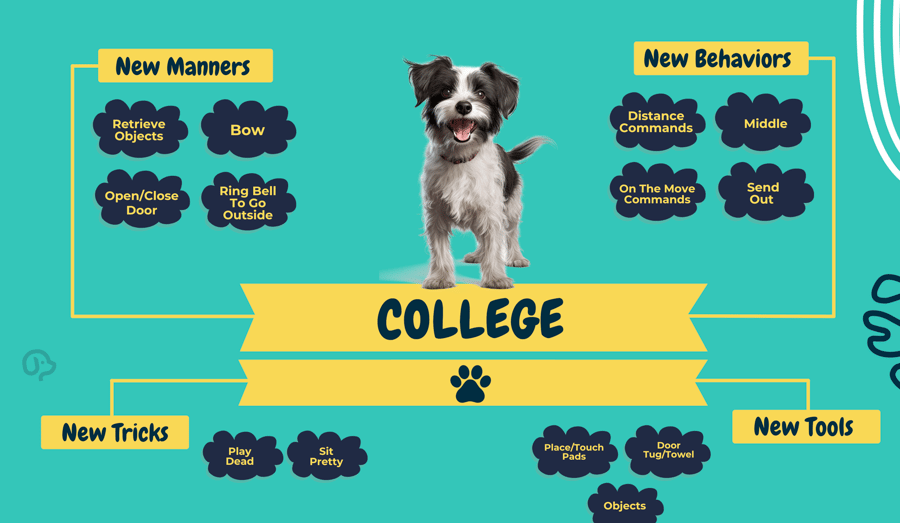
    College Syllabus

    New Manners

    Retrieve ObjectsBowOpen/Close DoorRing Bell To Go Outside

    New Behaviors

    Distance CommandsMiddleSend OutOn The Move Commands

    New Tricks

    Play DeadSit Pretty

    New Tools

    Place/Touch PadsDoor Tug/TowelObjects (Named)

    15 new behaviors · 99 cumulative

    Masters

    All Ages

    Dogs establishing themselves as masters of body and mind reach new heights in this grade level. Navigate the difficulties of strengthening each known behavior around increasingly difficult environments. Bridge together intricate routines with a combination of precision, creativity, and advanced communication.

    This level emphasizes complex tricks, cooperative tasks, and performance-oriented skills, the routines you see at dog sport demonstrations and on social media.

    Complex Routines

    Dogs are trained in advanced behaviors like "Figure 8" and "Orbit," which involve intricate movements and demonstrate a high level of coordination and responsiveness.

    Task Completion

    Commands like "Put Toys Away" teach dogs to perform specific tasks independently, reinforcing their ability to understand and complete multi-step instructions.

    Creative Expression

    Through skills like "Wave," "Kiss," and "Freestyle Bridging," dogs engage in expressive behaviors that highlight their personality and the strong bond with their handler, making ...

    Masters Syllabus

    New Manners

    Wipe The FloorPut Away ToysTurn Off Lights

    New Behaviors

    Right Side PositionOrbitFigure 8CatchFreestyle Bridging

    New Tricks

    Tell A SecretWaveDanceKiss

    New Tools

    Light SwitchShoes & ClothesBox

    16 new behaviors · 115 cumulative

    Dogtorate

    All Ages

    Dogs achieve the highest level of training in Dogtorate, showcasing their exceptional abilities through dynamic and challenging performances. This level focuses on agility, precision, and complex tricks that demonstrate advanced skills and athleticism.

    Graduates at this level are the dogs you see headlining demonstrations, performing at events, and serving as ambassadors for everything Partners-trained dogs can become.

    Dynamic Performance

    Dogs master high-energy activities like "Frisbee" and "Leg Weaves," highlighting their agility, speed, and ability to follow intricate sequences in a fast-paced environment.

    Precision Tricks

    Commands such as "Cross Paws" require precise movements, showcasing the dog's advanced coordination and focus in executing detailed and controlled actions.

    Athletic Challenges

    Through tricks like "Leg Jump," dogs demonstrate their physical prowess and ability to perform challenging stunts, underscoring their strength, training, and trust in their ...

    Dogtorate Syllabus

    New Manners

    CountingBed Time

    New Behaviors

    Jump Through HoopJump Through ArmsJump Into ArmsLeg JumpLeg WeavesFrisbee

    New Tricks

    Cross PawsSkateboardShuffleLimp

    New Tools

    Frisbee DiscBlanketHoopSkateboard Deck

    Specialty Classes

    Sport-focused options for dogs who've graduated the curriculum or want a different kind of challenge.

    Dog and handler practicing precise heel, Rally-style coordination

    Rally

    Refine leash handling, commands, and partnership through the dynamic dog sport of Rally.

    Rally teaches the subtleties of obedience by refining leash handling, commands, and cultivating a well-rounded, proficient, and enthusiastic dog. Rally class is a wonderful opportunity for parents to strengthen the bond with their pets, stimulate them mentally and physically, ...
    Partners Dog School group class practicing agility-style work

    Agility

    Guide your dog through jumps, weaves, tunnels, and more, fun, fitness, and partnership.

    Agility training involves guiding your dog through various obstacles such as jumps, weaves, tunnels, and more. It's a fantastic way for parents to bond with their dogs, keep them physically and mentally active, and enjoy a rewarding and entertaining experience together. It's a ...

    Frequently asked

    Group Classes FAQs

    Real questions from real Partners Dogs families.

    Have a different question? Ask us.

    What are group classes at Partners Dogs?

    Group classes at Partners Dogs are weekly small-group training sessions at our Scottsdale and Cave Creek campuses. Dogs progress through 8 cumulative grade levels, from Pre-School to Dogtorate, covering 115 behaviors tracked in the PD360 system.

    The curriculum is cumulative: behaviors taught at Elementary are reinforced in Middle-School and proofed in High-School, with each behavior moving through at least four stages of learning. Sessions are taught by master trainers in groups of 6 dogs or fewer, and open enrollment runs year-round, so you can start any week without waiting for a new session. Drop-in classes are $65 per session with no long-term contracts. Rally and Agility specialty classes are also available.

    How much do group classes cost at Partners Dogs?

    Drop-in group classes are $65 per session, with no contracts and no long-term commitments. Same-day enrollment at the door is $115, so booking ahead saves you $50. Multi-class packages are available for families who want a regular weekly slot. Each class runs 45 minutes, held once per week, with open enrollment year-round.

    Pricing is per dog. If you have multiple dogs, contact us about household pricing. View current pricing and package options on the pricing page.

    How many dogs are in a group class?

    Classes run with six dogs or fewer per session, taught by master trainers. That size keeps the coaching personal: during the 20-minute interval block your trainer works with you one-on-one, while the rest of the class provides the social, real-world distraction that makes new skills stick.

    If your dog needs more focused attention before joining a group, start with a PD360 assessment or private lessons.

    What group class levels do you offer?

    Partners Dogs teaches a modular 8-grade-level curriculum covering 115 behaviors in the PD360 system, and the catalog keeps growing as our trainers add new skills:

    • Pre-School: manners, socialization, confidence, and proper play, with separate Puppy and Adult tracks (puppies start between 8 weeks and 5 months)
    • Kindergarten: heel, place, stay, free, and thresholds, the foundations every later level builds on
    • Elementary: the everyday commands, Reset, Done, Leave It, and Off, plus impulse control
    • Middle-School: structured off-leash work, grooming tolerance, and desensitization
    • High-School: retrieve, pacing, and real-world proofing around children, sounds, and handling
    • College: distance commands, Middle, Send Out, and functional household tasks
    • Masters: complex routines like Figure 8, Orbit, and Put Toys Away
    • Dogtorate: frisbee, leg weaves, and performance-level athleticism

    Rally and Agility run as specialty classes alongside the curriculum, and graduates can add AKC Canine Good Citizen prep and testing. A behavior taught at one level is reinforced at the next and proofed above that, so the same skill keeps deepening as your dog climbs. Open enrollment lets you join any week and progress at your own pace.

    What does my dog learn in Kindergarten?

    Kindergarten is where everyday manners take root. Your dog learns to wait at thresholds instead of bolting through doors, heel through turns, come to a front position on recall, and hold a stay or place until released with the free command. Manners work covers appropriate play, calm handoffs between handlers, and desensitization to new sights and sounds, so confidence grows where reactivity used to.

    Every skill is tracked individually in PD360 and moves through Teaching, Reinforcing, Proofing, and Maintenance until it holds up around real-world distraction, not just in class.

    What does my dog learn in High-School?

    High-School turns a well-trained dog into a genuinely useful partner. Dogs refine pivots, turns, and pacing so they match your speed instead of pulling ahead, master retrieve for practical tasks, and add the bye command. New tricks like speak, high five, and hug keep sessions fun while deepening cooperation.

    Manners work targets real life: calm behavior around children, and medical socialization where your dog learns to relax while vitals are taken, a skill that makes vet visits dramatically easier.

    Does my dog need experience before starting Kindergarten?

    No prior training is required, just a PD360 assessment so we can confirm the right starting grade. Many dogs graduate into Kindergarten from Pre-School, while adult dogs with some home training often place straight into it. Placement is based on demonstrated skill, temperament, and training history, never on age alone.

    Classes run on a 12-week rotating cycle with open enrollment, so there is no session to wait for. Join any week, drop in for $65 per 45-minute class, and repeat any week your dog needs before testing up to Elementary.

    Is High-School where my dog works off leash?

    Dogs enter High-School already carrying off-leash commands and heel from Middle School, and this level is where that reliability gets proofed. Known skills keep cycling through Reinforcing, Proofing, and Maintenance around controlled noise, movement, and other dogs, so obedience holds up in the situations that used to unravel it.

    Not sure your dog is ready? The PD360 assessment settles it. Every dog is placed by demonstrated skill, not time enrolled, so your dog starts exactly where the score says they should.

    Can group classes address my dog's behavior problems?

    Group classes build manners, real-world skills, and social confidence. They are not behavior modification. Dogs who are mildly uncomfortable or distractible around other dogs often do well starting in Pre-School on the Adult track, where confidence and desensitization come first.

    If your dog lunges, has a bite history, or panics around dogs or people, individualized work comes first: Behavior Camp for reactivity, anxiety, and resource guarding, Transform Camp for severe aggression, or the Leash Reactivity Intensive for on-leash reactivity. A $199 PD360 assessment gives you an honest read on where to start. Or take our 2-minute quiz.

    Why are board-and-train programs more expensive than group classes?

    Board-and-train and group classes solve different problems at different intensities.

    • Group classes ($65 drop-in, or monthly class packages from $169) teach you to train your dog with weekly group instruction. You do the daily work; we coach. Great for puppies, well-mannered dogs, and skill-building.
    • Board-and-train camps ($3,509 to $8,929) put your dog in our facility for 14 to 28 nights of immersive professional training, with private lessons for your family afterward. You get a dog who already understands the work, plus the coaching to maintain it. Right answer for serious behavior issues, fast turnaround, or dogs whose owners need a head start.

    Board-and-train pricing reflects 14 to 28 nights of dedicated trainer time, lodging, daily handling, private follow-up lessons, and the weeks of group classes that come after camp.

    Not sure which fits? Take the program quiz or schedule a call.

    Are there age or breed restrictions for group classes?

    Dogs join standard group classes from 20 weeks (about 5 months) old, once vaccinations have had time to take effect. Pre-School runs two tracks so your dog learns alongside peers at a similar life stage: Puppy (5 to 12 months) and Adult (12 months and up). Puppies younger than 5 months start in our Puppy Program and graduate into Pre-School.

    There are no breed restrictions. We welcome dogs of every shape, size, and breed. All dogs begin with a PD360 assessment so we can place them in the right grade level based on skill, temperament, and training history.

    When does the next group class session start?

    Group classes run year-round with open enrollment, so you can start any week, no waiting for a new session to begin. Each class is 45 minutes, held once per week. Our modular class structure means you can join any time and progress through the grade levels at your own pace, with no set start or end date.

    Class schedules vary by location and level. Check the current schedule at our Scottsdale or Cave Creek facility, or call 480-595-6700 to find the next class that fits your schedule.

    Providing Dog Training Solutions In Arizona

    480.595.6700

    Ready to Enroll?

    Drop-in classes are $65 per session ($115 same-day at the door) with no contracts. Open enrollment means you can start this week.