Skip to content
Family-owned · Est. 1997 70,000+ dogs trained 4.8 stars · 2,000+ parent reviews
    Home
    Programs
    Locations
    Resources
    Shop

    Dog Behavior Solutions

    Take a Walk Without the Tug-of-War

    Sore shoulders and constant bracing make walks feel like work. Partners Dogs helps your dog move with you so the neighborhood becomes part of normal life again.
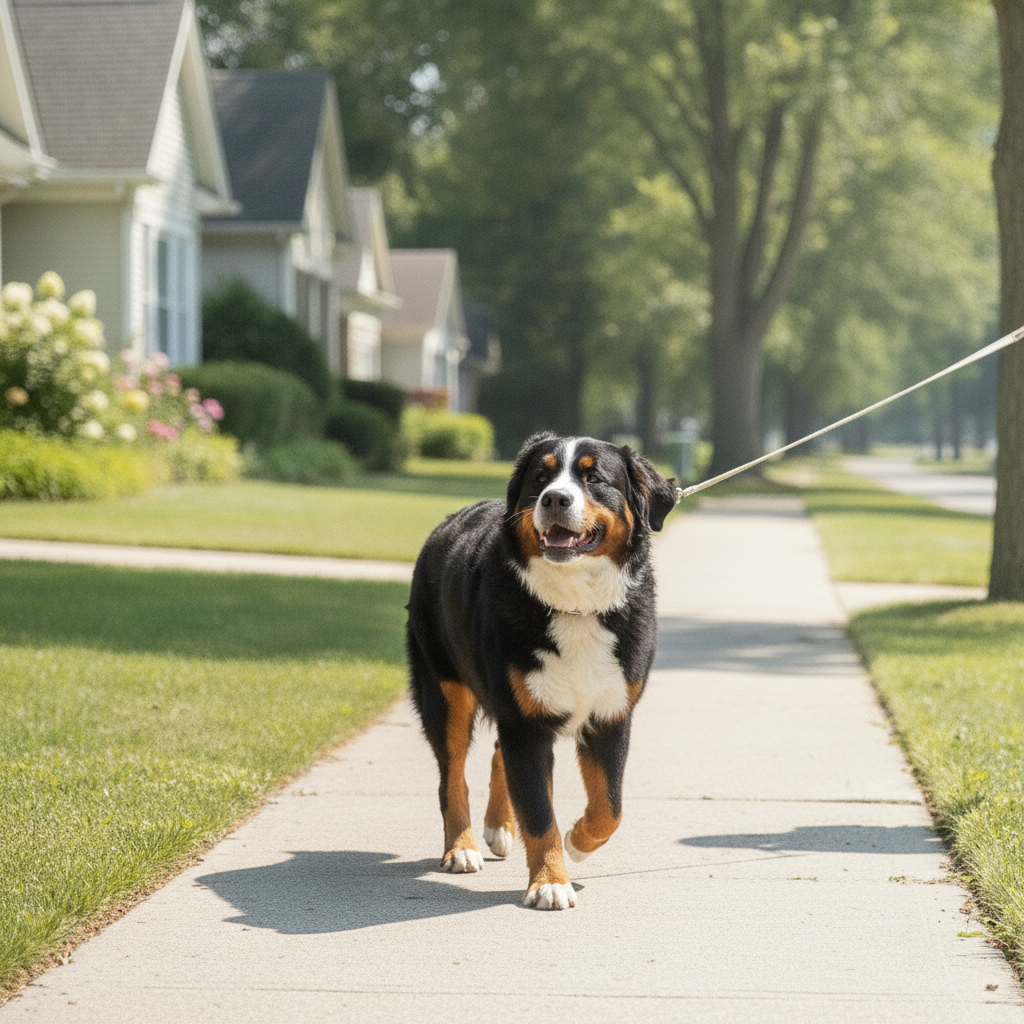
    Calm Bernese Mountain Dog walking on a loose leash, looking up happily at its owner after Partners Dogs leash training

    Behavior severity

    Mild

    What you may be seeing

    Common signs

    • Constant leash tension or surging toward smells and movement
    • Zigzagging, lagging, or circling the handler
    • Pulling harder at the start of a walk
    • Losing responsiveness as distractions increase
    • Coughing or discomfort from pressure on the neck

    Seek help now

    • Pulling that causes a fall, injury, or escape from equipment
    • Barking, lunging, snapping, or redirected biting at triggers
    • Breathing difficulty, collapse, or persistent coughing
    • Sudden change in gait, stamina, or willingness to walk

    Mild is a starting point for planning, not a diagnosis. Injury, respiratory signs, aggression, or sudden change warrants veterinary care or an in-person assessment.

    Understanding the behavior

    What is pulling on leash?

    Pulling continues because it moves the dog toward smells, people, shade, and other rewards. Equipment can improve comfort and safety, but the dog also needs to learn where reinforcement happens and how pace changes with leash tension.

    Loose-leash work begins in manageable settings and adds distractions gradually. The handler's timing, route, equipment fit, and reinforcement all matter. Pulling toward a trigger with barking or lunging may be leash reactivity and needs a different risk assessment.

    Many dogs improve with clear practice, but reliable walking across settings takes maintenance. The goal is a comfortable, controllable walk, not a rigid position for every step.

    Partners Dogs has trained Arizona dogs through every kind of pulling on leash case since 1997, at our Scottsdale and Cave Creek facilities. Lifetime trainer support is included with every board-and-train program.

    Adult Bernese Mountain Dog pulling hard on a tight leash, dragging its owner down a sidewalk, before Partners Dogs training

    The transformation

    Before and after training

    Drag the slider to see the change our programs make for a dog with pulling on leash. Same dog, same home, real outcome.
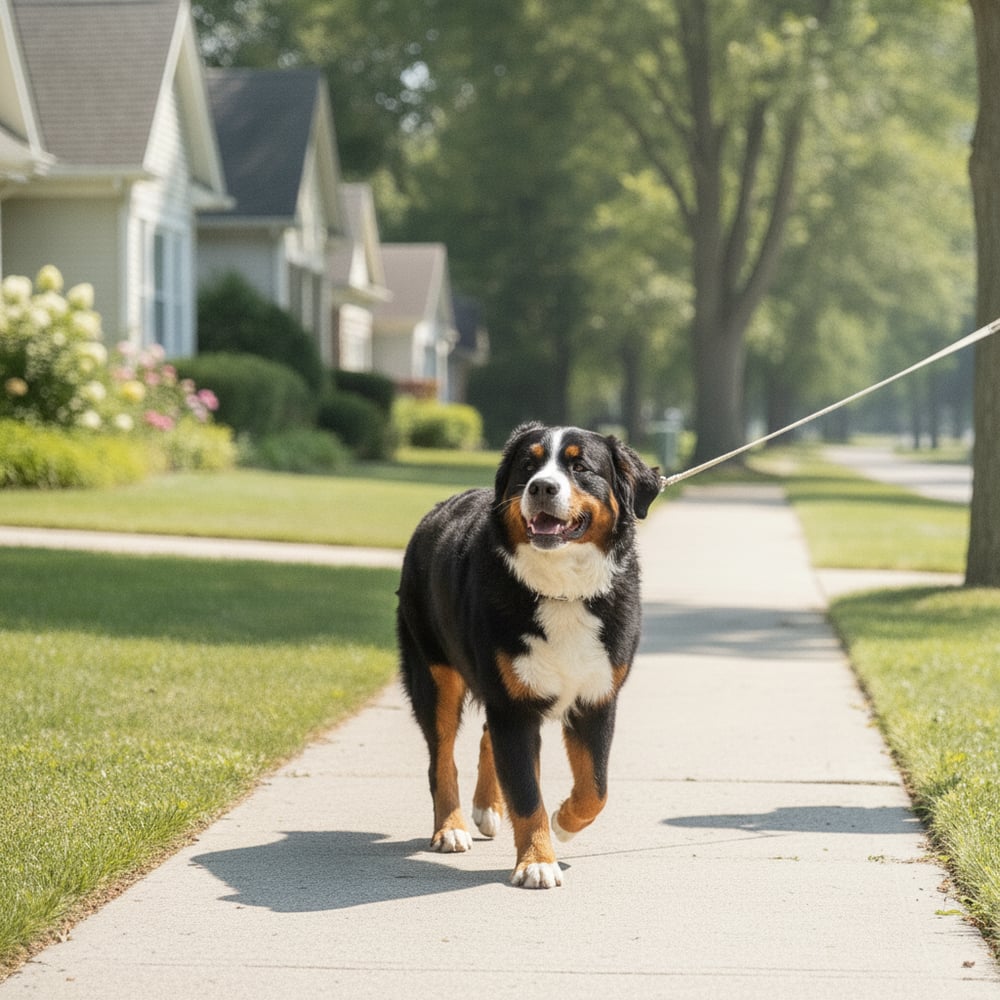
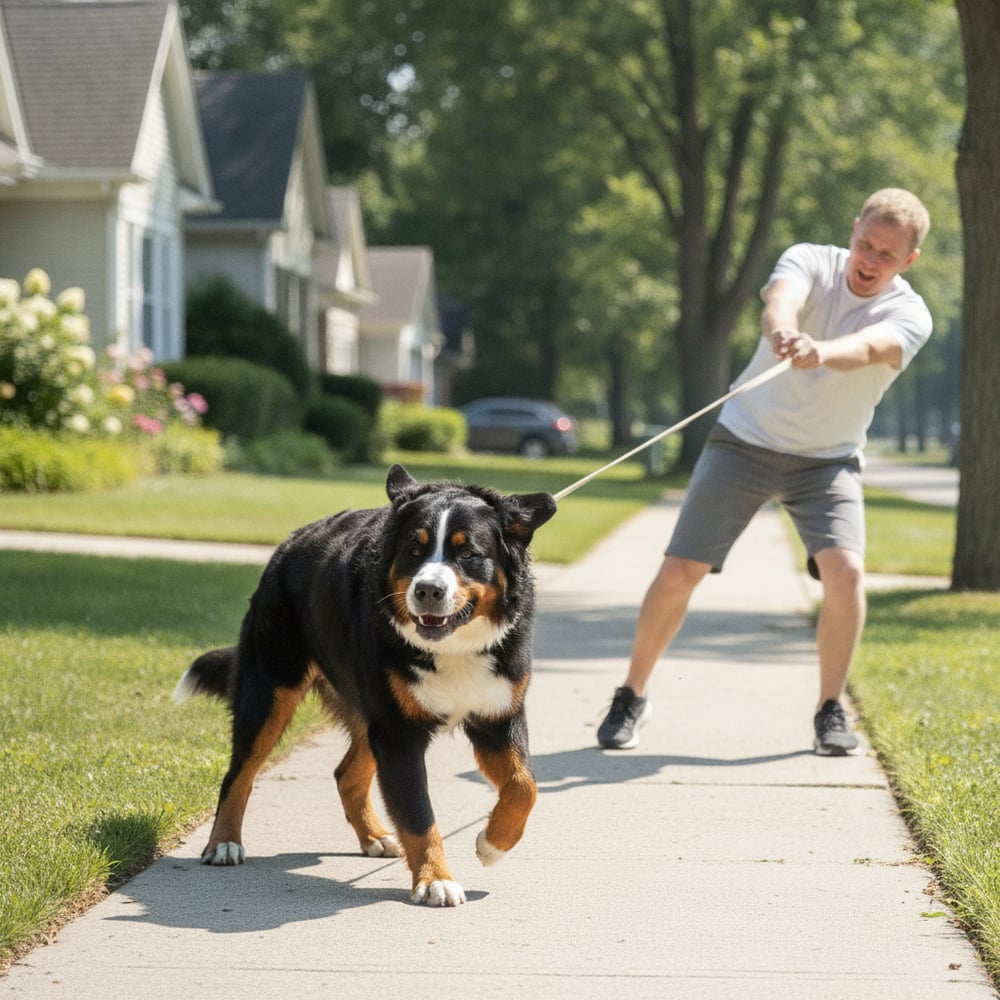
    Calm Bernese Mountain Dog walking on a loose leash, looking up happily at its owner after Partners Dogs leash training Adult Bernese Mountain Dog pulling hard on a tight leash, dragging its owner down a sidewalk, before Partners Dogs training

    Watch

    How we work on pulling on leash

    Short walkthroughs from our trainers on the exact techniques we use to resolve pulling on leash. See how the work actually looks, then choose the path that fits your dog.

    Thalia  Episode 1 video thumbnail
    Thalia Episode 1
    70,000+Dogs Trained
    28+Years Experience
    4.8★Average Rating
    2Arizona Campuses

    Recommended path · Mild severity

    The right program for pulling on leash

    Based on how pulling on leash typically presents, here is where we would start. Not sure which fits? Take the PD360 assessment for a personalized recommendation.

    Alternative

    Group Classes

    Weekly Pet Parenting classes with our trainers, practice in a structured social environment.

    The process

    How it works

    1

    Assessment and check-in

    • We verify vaccination records and complete pre-check-in forms.
    • Your dog receives a full behavioral assessment.
    • We set goals and build a personalized training plan.
    • You meet the primary trainer and tour the facility.
    2

    Training and progress reports

    • Multiple active training sessions every day.
    • Controlled exposure and desensitization to triggers.
    • Immersive socialization in a managed environment.
    • Regular progress reports with photos and video.
    3

    Transition and follow-up

    • Private lessons that transfer the training to you.
    • Pet Parenting group classes for ongoing support.
    • Access to our full Pet Parent Guide.
    • Weeks of follow-up so the change lasts at home.

    Not sure which program

    Get a recommendation in minutes

    Take our quick PD360 assessment for a personalized recommendation, or talk to a trainer who has seen pulling on leash many times before.

    What our clients say

    “"My arm literally hurt from walking Beau every morning. I switched leashes, tried every harness, watched every video, nothing lasted more than two days. After Foundation Camp, I walked him down the Greenbelt and he stayed right at my side the whole time. I actually teared up a little. It sounds ridiculous but it was such a relief."”

    Christine H.

    “"I'm not a small person and my dog still managed to pull me into a fence. We did Foundation Camp and the trainers at Partners rebuilt how he thinks about walking on leash. Now another responsible family member can handle him. That's how different it is."”

    Dave M.

    Live Reviews

    What our families are saying

    Real reviews from real families across our Scottsdale and Cave Creek campuses.

    4.8average rating
    2,000+reviews collected

    Showing 12 recent reviews

    Christi B. Cave Creek Sep 2026 Google

    Excellent experience for our adopted puppy and for me! The staff are amazing, caring, and knowledgeable. Our puppy has learned so many valuable skills, including socialization and walking on a leash, and has become much more confident around other dogs. I’ve also learned a lot about training and how to better support our puppy at home.

    Marina S. Cave Creek Sep 2026 Google

    We had to go out of town and had absolutely no one to watch our furry friend. I trust the opinions of a few staff members and decided it was time for our girls first boarding session. I knew my dog was going to get absolutely loved on and taken good care of, even without add ons like training sessions or daycare. That she was! I have never seen this girl happier to just exist somewhere other than home or her favorite park. Staff communication was on point, especially at pick up when a kennel worker was explaining she ruined her dog bed, asking if I still wanted to take it home. So sweet. Some other staff could use some training on how to be personable, but over all 10/10 would recommend.

    Emily T. Scottsdale Sep 2026 Google

    all of the staff are so kind and attentive. Val has been working 1 on 1 with my puppy and she has been amazing my puppy always leaves happy and will be tired all day when she comes home I’ve had to make 2 changes and they were so accommodating and kind about it please if you are looking into this resort for any type of service I highly recommend

    Boyd D. Cave Creek Sep 2026 Google

    Chastity all 3 of my guys. The Huskys the worst. When he comes out of the trailer, man he's Handsome

    Dan P. Cave Creek Sep 2026 Google

    Lucy and Noa have been so great to work with!

    Cheryl S. Cave Creek Sep 2026 Google

    The people nd trainers are 150% awesome. The cost takes a little getting used to but likely worth it.

    Norbert D. Scottsdale Sep 2026 Google

    Sky is always excited to spend days at her favorite dog hotel… she is also happy when we pick her up, all fed and washed. Great place.

    Ursula A. Scottsdale Sep 2026 Google

    We had an great experience with our dog training. The training was professional, patient, knowledgeable, and truly worked with us to get what our dog needed. We especially appreciated the guidance and support in earning our AKC Community Canine (CGCA) and AKC Urban Canine (CGCU) certificates. Every step was clearly explained, and the classes gave plenty of group time with practical tools that helped build our dog’s confidence, manners, and skills in real-world situations. If you are looking for relaxed and patient trainers who genuinely cares about both the dog and the people at the other end of the leash, we recommend them.

    Nancy S. Scottsdale Sep 2026 Google

    The facility and staff are always very friendly and attentive. I love the concept of the dogs being able to play while they are also reinforcing their training! My dog always loves going to daycare and best of all I know he is being taken care of and is having fun with his friends. Thank you, Partners!!!!!

    John Y. Scottsdale Aug 2026 Google

    Great staff, our dog loves going there.She gets very excited when we say want to go to partners.

    Judy S. Scottsdale Jul 2026 Google

    Our Bouvier (Willie)loves everything about Partners. He looks forward to the daycare, parents class, and even boarding. He loves this facility as much as the staff loves him. I can't say enough good things about this place.

    Janet S. Scottsdale Jul 2026 Google

    Always a great experience. Staff are dedicated to the dogs and are extremely helpful.

    Loved working with us? Leave a review

    Good to know

    Frequently asked questions

    Can an older dog still learn to walk without pulling?

    Yes, absolutely. There is no age cutoff on loose-leash walking, and older dogs often pick it up faster than young, high-energy ones.

    • It's a mechanical skill, not a developmental window. Unlike some social behaviors, loose-leash walking is straightforward conditioning that works at any age.
    • Older dogs often have an advantage. More natural impulse control and a longer attention span than an adolescent dog mid-hormone-surge can make the training move faster, not slower.
    • One caveat: check for pain first. A senior or previously easygoing dog who suddenly starts pulling hard may be moving differently because of joint pain, vision changes, or hearing loss, not a new behavior problem. Rule that out with your vet before starting training.

    Once medical causes are ruled out, the same loose-leash protocol we use with young dogs works just as well for a ten-year-old.

    What program helps with pulling on leash, and what does it cost?

    Pulling on leash typically responds to Foundation Camp, our 14-day board-and-train that installs loose-leash mechanics ($3,509, discounted with membership), or weekly Group Classes for continued hands-on practice. A $199 PD360 Assessment, credited toward enrollment in your recommended camp or membership (not toward à la carte bookings or general reservations), helps rule out a reactivity component before we recommend the right path.

    What's the best collar or harness to stop my dog from pulling?

    Equipment helps, but no piece of gear teaches loose-leash walking on its own. That said, here is how we think about it at Partners Dogs:

    • Structured six-foot leash + slip lead: our default training setup. When fitted high on the neck and used correctly, a slip lead gives you clean, direct communication that translates into a dog who actually listens on leash.
    • Prong collar: often safer than a flat collar for hard pullers who choke themselves. Fitted correctly and paired with leash skills, it communicates clearly without escalating force.
    • e-Collar: for off-leash work and advanced cases where leash equipment alone isn't the right answer.
    • Flat collar + six-foot leash: the everyday maintenance baseline once your dog has the skill. It is not a training tool on its own. It is what you graduate to.
    • Front-clip harness: physical management only. It provides minimal training communication and is not a primary training tool. Useful only briefly when transitioning from a chronic puller toward a controlled walker.
    • Retractable / flexi leashes: we do not use them. They teach pulling and make handling unsafe.

    The right tool depends on your dog's size, drive, and how the pulling combines with other behavior. We are tool-agnostic by design. We pick what works for your specific dog. Tools don't cause harm or pain. People do. The trainer's skill is what makes any piece of equipment safe and effective.

    What's the difference between pulling and leash reactivity?

    They look similar at the end of the leash but they are different problems:

    • Pulling is mechanical. Your dog moves forward, faster than you, all the time, toward everything. It is steady forward pressure with no real emotional component.
    • Reactivity is emotional. Your dog is fine until a specific trigger appears (another dog, a stranger, a bike), then explodes into barking, lunging, and spinning. They may be relaxed two minutes later.

    Many dogs have both. They pull when calm and react when triggered. The training plans overlap (both build engagement and impulse control), but reactivity requires additional work on the dog's emotional response to the trigger. That is why severe reactivity is usually a Behavior Camp case, while plain pulling is a Foundation Camp case.

    Why does my dog pull so hard on the leash?

    Dogs pull because pulling works. Every step you take while the leash is tight, your dog has just been rewarded for pulling. They got closer to whatever they wanted. After a few hundred reps, the dog has learned that tight leash equals forward motion. The fix is not a stronger collar, it is changing what tight-leash predicts.

    A few common contributors we see in Scottsdale and Cave Creek:

    • Under-exercised dogs are carrying too much energy onto the leash from the start.
    • High-drive breeds (huskies, shepherds, hounds, sporting breeds) have generations of selection pressure for pulling and running ahead.
    • Never-taught loose-leash mechanics: most dogs were simply never shown that a loose leash is what produces forward motion.

    Loose-leash walking is one of the most teachable skills in dog training. It is not personality. It is mechanics that no one has installed yet.

    Why does my dog pull even though I've tried different leashes and harnesses?

    Switching equipment can make pulling more manageable, but it rarely fixes it on its own, because pulling continues as long as it still works. Every step your dog takes while the leash is tight, if that tight leash still gets them closer to a smell, a person, or another dog, they are being rewarded for pulling regardless of what is clipped to their collar. Real loose leash walking training changes what a tight leash predicts: instead of forward motion, it starts predicting a pause or a direction change, until slack becomes the thing that actually gets your dog where they want to go.

    Ready for the next step

    Talk to a trainer now

    Every dog and household is different. Get a real conversation with a Partners Dogs trainer who has treated pulling on leash for more than 28 years. Take what you learn home and talk it over before you commit to anything.