Skip to content
Family-owned · Est. 1997 70,000+ dogs trained 4.8 stars · 2,000+ parent reviews
    Home
    Programs
    Locations
    Resources
    Shop

    Dog Behavior Solutions

    Make the Front Door and Fence Safer

    Territorial aggression can put guests, workers, neighbors, and your dog at risk. Partners Dogs starts with secure management and a direct assessment before another routine approach becomes an incident.
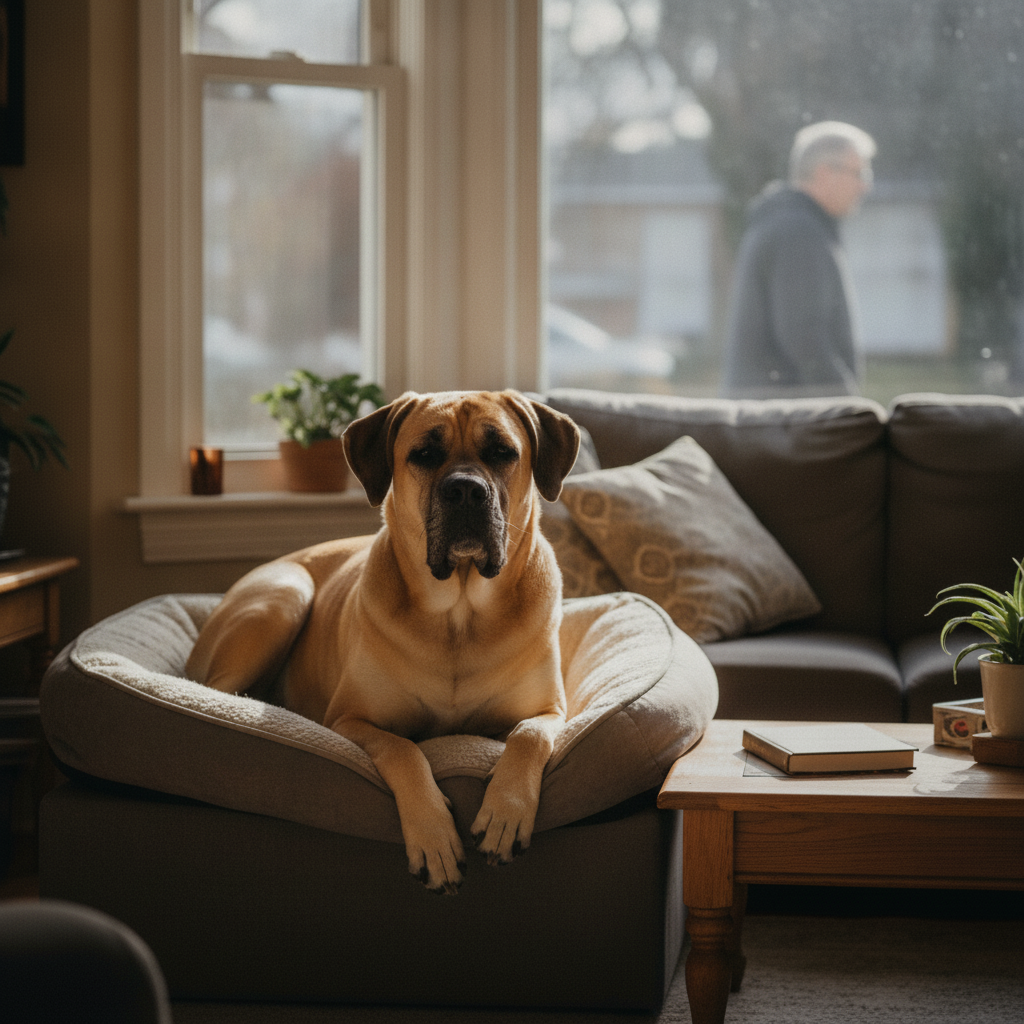
    Calm fawn Cane Corso resting relaxed on a bed by the window after Partners Dogs territorial aggression training.

    Behavior severity

    Severe

    What you may be seeing

    Common signs

    • Charging, barking, growling, or lunging at doors, fences, windows, or gates
    • Targeting delivery workers, visitors, neighbors, or passing dogs
    • Becoming harder to interrupt as someone approaches
    • Guarding inside after a guest enters
    • Fence damage or repeated attempts to reach the trigger

    Seek help now

    • Any bite, attempted bite, pursuit, or barrier breach
    • Aggression toward a child, worker, guest, or neighbor
    • Redirected biting when the dog is removed
    • Sudden onset, pain, confusion, or rapid escalation

    Severe is a starting point for planning, not a diagnosis. Use two secure barriers and arrange veterinary care plus an in-person assessment before visitor or fence-line exercises.

    Understanding the behavior

    What is territorial aggression?

    Territorial aggression is threatening or aggressive behavior toward people or animals approaching a space the dog treats as its own. It may appear at doors, gates, fences, vehicles, yards, or inside the home. Fear, guarding, barrier frustration, and learned success can overlap with territorial motivation.

    Every retreating delivery worker or passing dog can reinforce the pattern from the dog's perspective. Management changes that rehearsal. Locked gates, visual barriers, indoor confinement before opening the door, leash backups, and written visitor rules protect everyone while training begins.

    Any bite or sudden onset warrants veterinary evaluation. Severe cases receive an in-person assessment before program placement. Many dogs can become safer and easier to manage, but property access may always require rules and barriers. No plan can guarantee that territorial risk disappears.

    Partners Dogs has trained Arizona dogs through every kind of territorial aggression case since 1997, at our Scottsdale and Cave Creek facilities. Lifetime trainer support is included with every board-and-train program.

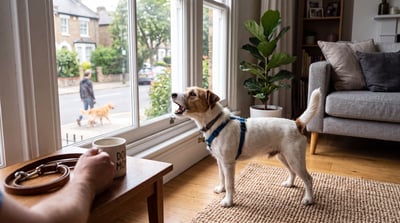
    Fawn Cane Corso standing alert at a living room window barking at a passerby, showing territorial guarding behavior before training.

    The transformation

    Before and after training

    Drag the slider to see the change our programs make for a dog with territorial aggression. Same dog, same home, real outcome.
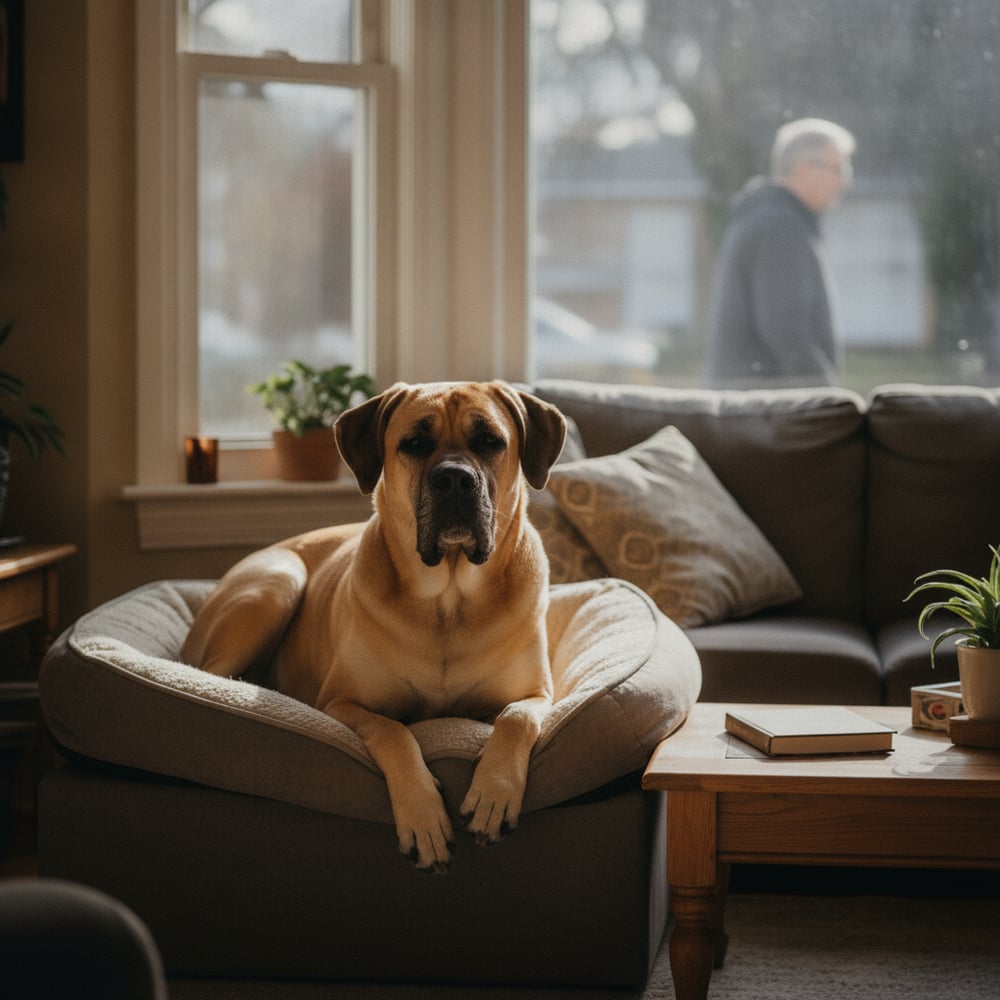
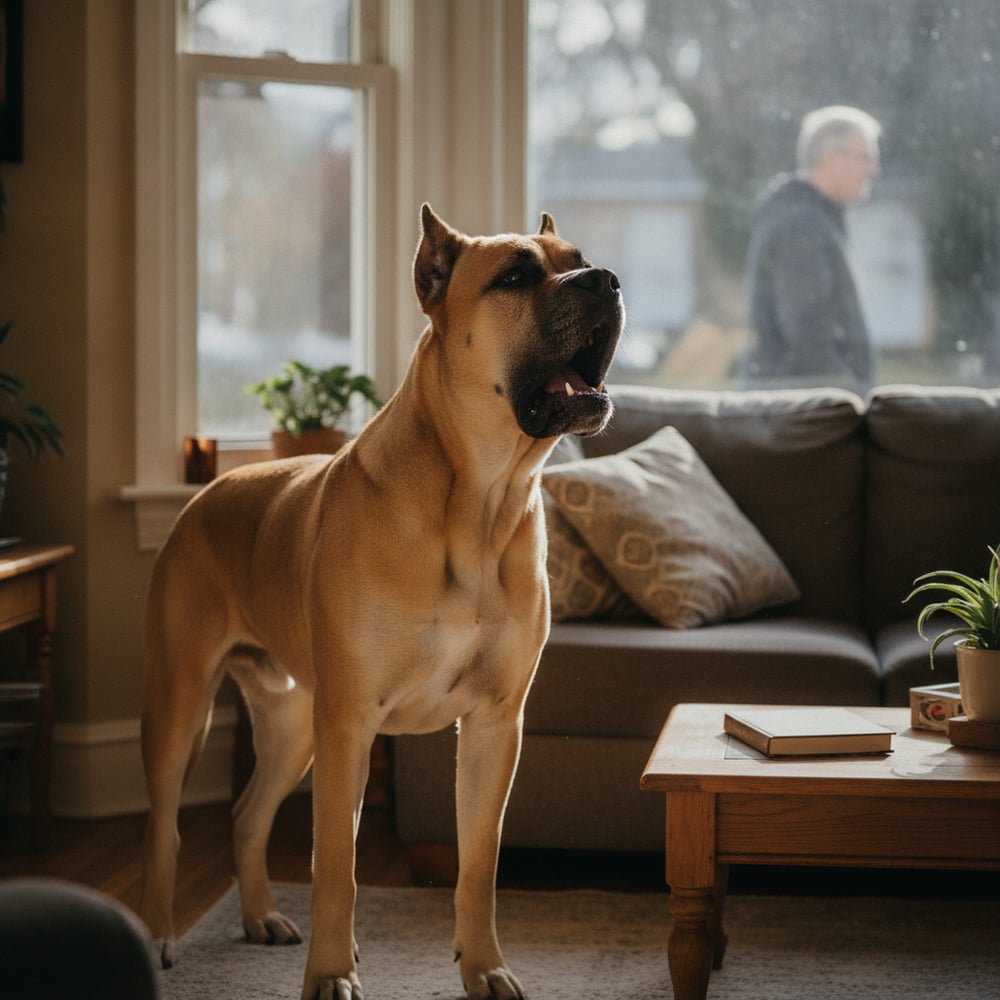
    Calm fawn Cane Corso resting relaxed on a bed by the window after Partners Dogs territorial aggression training. Fawn Cane Corso standing alert at a living room window barking at a passerby, showing territorial guarding behavior before training.

    Watch

    How we work on territorial aggression

    Short walkthroughs from our trainers on the exact techniques we use to resolve territorial aggression. See how the work actually looks, then choose the path that fits your dog.

    Reactivity  Territorial video thumbnail
    Reactivity Territorial
    70,000+Dogs Trained
    28+Years Experience
    4.8★Average Rating
    2Arizona Campuses

    Recommended path · Severe severity

    The right program for territorial aggression

    Based on how territorial aggression typically presents, here is where we would start. Not sure which fits? Take the PD360 assessment for a personalized recommendation.

    Alternative

    Private Lessons

    One-on-one work at our facility or your home, ideal for transferring skills and handling triggers in real environments.

    The process

    How it works

    1

    Assessment and check-in

    • We verify vaccination records and complete pre-check-in forms.
    • Your dog receives a full behavioral assessment.
    • We set goals and build a personalized training plan.
    • You meet the primary trainer and tour the facility.
    2

    Training and progress reports

    • Multiple active training sessions every day.
    • Controlled exposure and desensitization to triggers.
    • Immersive socialization in a managed environment.
    • Regular progress reports with photos and video.
    3

    Transition and follow-up

    • Private lessons that transfer the training to you.
    • Pet Parenting group classes for ongoing support.
    • Access to our full Pet Parent Guide.
    • Weeks of follow-up so the change lasts at home.

    Not sure which program

    Get a recommendation in minutes

    Take our quick PD360 assessment for a personalized recommendation, or talk to a trainer who has seen territorial aggression many times before.

    What our clients say

    “"Our HOA had cited us twice for our dog scaring residents at the fence. We'd tried everything, spray bottles, citronella collars, shouting. Nothing worked. The Partners team explained exactly what was maintaining the behavior and why our corrections were making it worse. Transform Camp helped us build a yard routine we can manage safely. It was the best money we ever spent on him."”

    Tom and Sheila B.

    “"A FedEx driver had filed a complaint about our dog. I was mortified and genuinely worried about what might happen next. The assessment at Partners was thorough and honest. They didn't sugarcoat the severity, but they also didn't tell me to give up on her. Behavior Camp addressed the territorial pattern. She can hear the truck now without going into the same zone. I didn't think it was possible."”

    Diana K.

    Live Reviews

    What our families are saying

    Real reviews from real families across our Scottsdale and Cave Creek campuses.

    4.8average rating
    2,000+reviews collected

    Showing 12 recent reviews

    Christi B. Cave Creek Sep 2026 Google

    Excellent experience for our adopted puppy and for me! The staff are amazing, caring, and knowledgeable. Our puppy has learned so many valuable skills, including socialization and walking on a leash, and has become much more confident around other dogs. I’ve also learned a lot about training and how to better support our puppy at home.

    Marina S. Cave Creek Sep 2026 Google

    We had to go out of town and had absolutely no one to watch our furry friend. I trust the opinions of a few staff members and decided it was time for our girls first boarding session. I knew my dog was going to get absolutely loved on and taken good care of, even without add ons like training sessions or daycare. That she was! I have never seen this girl happier to just exist somewhere other than home or her favorite park. Staff communication was on point, especially at pick up when a kennel worker was explaining she ruined her dog bed, asking if I still wanted to take it home. So sweet. Some other staff could use some training on how to be personable, but over all 10/10 would recommend.

    Emily T. Scottsdale Sep 2026 Google

    all of the staff are so kind and attentive. Val has been working 1 on 1 with my puppy and she has been amazing my puppy always leaves happy and will be tired all day when she comes home I’ve had to make 2 changes and they were so accommodating and kind about it please if you are looking into this resort for any type of service I highly recommend

    Boyd D. Cave Creek Sep 2026 Google

    Chastity all 3 of my guys. The Huskys the worst. When he comes out of the trailer, man he's Handsome

    Dan P. Cave Creek Sep 2026 Google

    Lucy and Noa have been so great to work with!

    Cheryl S. Cave Creek Sep 2026 Google

    The people nd trainers are 150% awesome. The cost takes a little getting used to but likely worth it.

    Norbert D. Scottsdale Sep 2026 Google

    Sky is always excited to spend days at her favorite dog hotel… she is also happy when we pick her up, all fed and washed. Great place.

    Ursula A. Scottsdale Sep 2026 Google

    We had an great experience with our dog training. The training was professional, patient, knowledgeable, and truly worked with us to get what our dog needed. We especially appreciated the guidance and support in earning our AKC Community Canine (CGCA) and AKC Urban Canine (CGCU) certificates. Every step was clearly explained, and the classes gave plenty of group time with practical tools that helped build our dog’s confidence, manners, and skills in real-world situations. If you are looking for relaxed and patient trainers who genuinely cares about both the dog and the people at the other end of the leash, we recommend them.

    Nancy S. Scottsdale Sep 2026 Google

    The facility and staff are always very friendly and attentive. I love the concept of the dogs being able to play while they are also reinforcing their training! My dog always loves going to daycare and best of all I know he is being taken care of and is having fun with his friends. Thank you, Partners!!!!!

    John Y. Scottsdale Aug 2026 Google

    Great staff, our dog loves going there.She gets very excited when we say want to go to partners.

    Judy S. Scottsdale Jul 2026 Google

    Our Bouvier (Willie)loves everything about Partners. He looks forward to the daycare, parents class, and even boarding. He loves this facility as much as the staff loves him. I can't say enough good things about this place.

    Janet S. Scottsdale Jul 2026 Google

    Always a great experience. Staff are dedicated to the dogs and are extremely helpful.

    Loved working with us? Leave a review

    Good to know

    Frequently asked questions

    Is territorial aggression in the car the same as at home?

    Same underlying cause, your dog is treating a space as territory worth defending, but the car version often shows up more intensely, and for a specific reason.

    • Confinement changes the equation. At home, a dog has room to retreat or disengage. In a car, they are physically stuck in a small space with the “intruder” (a passing person, another dog, a car pulling alongside), which can ramp up the intensity.
    • The trigger window is narrower and faster. Cars move past quickly, giving less time to intervene compared to a slower approach at the front door.
    • It needs its own dedicated work. Desensitization done at home doesn't always transfer automatically to the car. We build car-specific protocols: windows up initially, controlled exposure to passing triggers, and a clear settle cue used specifically in that context.

    If your dog is intense in the car, treat it as its own training priority rather than assuming home-door work will carry over.

    Why is my dog aggressive when people come to the house?

    Territorial aggression is when your dog treats the home, yard, car, or family as a resource to defend against intruders. It is different from stranger reactivity on walks because the behavior is context-specific, same dog might be perfectly fine meeting strangers at the park but bite the delivery driver at the door.

    Common drivers:

    • Genetics. Many guarding breeds were selected for exactly this behavior. Treating it requires working with the wiring, not against it.
    • Reinforcement. Every time a delivery driver walks away after your dog barked, the behavior was reinforced. The dog believes their guarding worked.
    • Insecure leadership in the household. Dogs who feel responsible for security tend to over-perform the role. Structure and predictability reduce the pressure.
    • Past intrusion event. A break-in, a confrontation at the door, a startling incident, can spike a dog into a defender role.

    At Partners Dogs territorial aggression with any bite history is a Transform Camp case. Without bite history, it may be a Behavior Camp case. Every case starts with a PD360 Assessment.

    Is territorial aggression the same as being a good guard dog?

    No, and this distinction matters more than most owners realize, because one is a useful trait and the other is a liability risk.

    • Healthy alert behavior is a dog who barks when someone approaches, then settles once you acknowledge it or the person is let in. The dog is informing you, not making the decision for you.
    • Territorial aggression is barking, lunging, or biting that continues regardless of your input, targets people who pose no real threat (the mail carrier, a delivery driver, an invited guest), and escalates rather than resolving once the “threat” is addressed.
    • The real difference is control. A dog with healthy alert instincts can be redirected. A dog with territorial aggression often cannot, even when you clearly signal the person is welcome.

    If your dog can't be called off once alerting starts, that is a training and liability issue worth addressing, not a feature to be proud of.

    What program is recommended for territorial aggression, and how much does it cost?

    Territorial aggression without bite history typically starts with Behavior Camp, our 21-day board-and-train ($6,244, discounted with membership); any bite history moves the recommendation to Transform Camp, our 28-day program ($8,929, discounted with membership). A $199 PD360 Assessment, credited toward enrollment in your recommended camp or membership (not toward à la carte bookings or general reservations), determines which path fits your dog's specific case.

    How do I stop my dog from being aggressive at the door?

    Door aggression is one of the most common territorial patterns, and it responds well to a structured protocol.

    • Manage first. A leash on your dog, a baby gate, or a crate during arrivals gives you control while training is still in progress. Do not skip this step hoping the training alone will hold under real pressure.
    • Teach a “place” or “go to mat” cue specifically tied to the doorbell or knock, so your dog has a clear job to do instead of rushing the door.
    • Practice with setups, not real deliveries. Have a family member knock and leave repeatedly so you can build the response under low-stakes conditions before testing it with an actual visitor or delivery.
    • Reward calm, which is more than quiet. A dog who stops barking but is still stiff and staring hasn't actually settled.

    This is core Behavior Camp work, and most door-aggression cases improve significantly with consistent practice.

    Ready for the next step

    Talk to a trainer now

    Every dog and household is different. Get a real conversation with a Partners Dogs trainer who has treated territorial aggression for more than 28 years. You get straight answers and a starting point that fits your home.